You are in a work meeting, coffee half drunk and the room screen switched on, when suddenly the door opens. People you were not expecting walk in, announce that they have planted a device and that the screen is about to start counting down. They leave, and the silence lasts exactly as long as it takes someone to let out a nervous laugh. That is how Defuse the Bomb begins, one of the most theatrical and most memorable team building activities in the Kaizen catalogue.
It is a race-against-the-clock game in which the group has to get through a series of challenges to win the code that defuses the bomb. In this article we explain how it works, what is at stake in each phase, what it genuinely develops in a team and what is worth bearing in mind before organising it, because it has an element of surprise that deserves some care.
The story: how the game starts
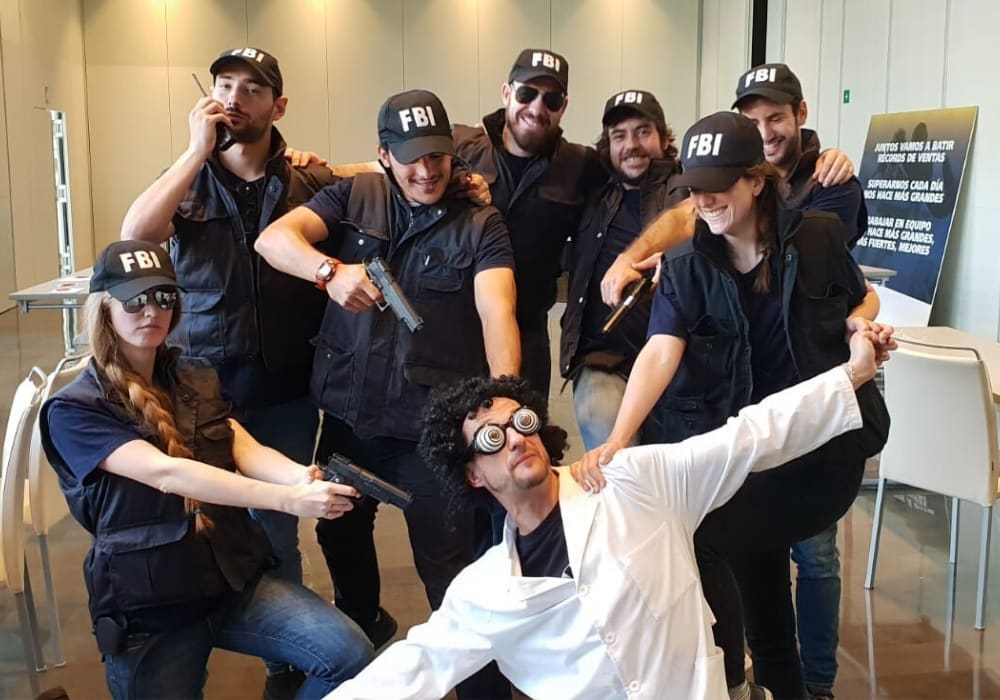
The activity is built like a small interactive play. While the group is holding a work meeting, a few intruders burst into the room and plant a bomb connected to the screen. On it you can see a countdown to the explosion. After setting out their demands, the intruders leave the room, leaving the participants with racing hearts and an amusing sense of not quite knowing what is going on.
Shortly afterwards the FBI negotiators appear, acting as go-betweens for the group and the intruders. They are the ones who pass on the demands in the form of tests and challenges. If the participants overcome them, they get the code to defuse the bomb. If they get stuck, the countdown carries on.
The key is that it is all a game and everyone knows it by the second minute, but the tension of the countdown and the actors' performances draw the group fully into the story. That immersion is what sets it apart from a simple contest of challenges.
What the group does during the activity
The overall structure is that of a mission game. The teams are given challenges to solve, normally combining ingenuity, communication and collaboration, and each solution brings them a little closer to the final code. The activity's description insists on one point that makes all the difference: the different teams must collaborate with one another, because sharing information can be decisive in a moment of crisis. You do not win by competing against the team next to you, but by coordinating with them.
That has interesting consequences. Groups that hoard information or do not listen to the others get stuck. Those that organise themselves, share what they know and divide up tasks make progress. And what happens in real work tends to happen here too: someone who seemed to be in the background turns out to hold the missing piece.
As for physical effort, it is very low or non-existent. What is needed is ingenuity, the ability to collaborate, optimism and a cool head in the tensest moments, such as when the countdown nears its end. That makes it accessible for almost any group.
What is included and who runs it
This is an activity with actors. According to Kaizen's description, what is included is precisely that team of performers who bring the characters (the intruders and the negotiators) to life. The location is an extra: it can be held in the company's own meeting room, a hotel function room or another suitable space, indoors or outdoors. In fact, the catalogue classes it as an outdoor, indoor and escape-type activity all at once.
If you are interested in activities based on solving a puzzle, we have other articles that can help you compare: escape rooms for companies and Cluedo for companies.
What it really develops in a team
The activity builds several skills at once, and does so in a way that people notice without anyone pointing it out. These are the ones that stand out most.
- Communication under pressure. With the clock running, it quickly becomes clear who listens, who explains clearly and who talks non-stop. It is a very visible training ground for something that is hard to work on in a normal meeting.
- Collaboration between teams. Having to share information breaks down the silos. It is very useful in organisations where departments tend to go their own way.
- Creativity and ingenuity. The challenges reward solutions that are not the most obvious. People who are less afraid of suggesting odd ideas often contribute a great deal.
- Managing nerves. Learning to make decisions under tension, without freezing or blaming anyone, is a skill with direct use in any professional setting.
- A shared sense of triumph. When the bomb is defused, the collective relief is enormous. The activity itself suggests that this boost to motivation and self-esteem can last for weeks or months, although, as always, it depends on how the experience is followed up within the company.
If you want to know how to carry what was experienced over into the workplace, and how to check whether it has worked, you will find more ideas in how to measure workplace climate before and after a team building.
How many people and how long it lasts
The activity is designed for groups from around 15 people up to more than 500, and lasts approximately two hours. With large groups, people are split into larger teams and coordination is reinforced so that everyone has a role. Two hours is a comfortable length: long enough to live the whole story and short enough for the pace not to flag, which makes it a good option to fit into a working day, before a lunch or at a convention with a tight agenda.
The element of surprise: what to take care over
The unexpected start is what gives the activity its sparkle, but it also calls for a little judgement. These are the things worth checking before you decide:
- Make sure the organisation is in the know. Ideally, the company's managers know about the activity in advance and, if it is held at an office, reception or security have been warned to avoid real scares. If it is at a hotel or an external venue, it is also advisable to inform the venue's staff.
- Review the tone for your team. The story has a dramatic premise. If you work with a group that is particularly sensitive to that kind of theme, or if there has been a recent event that might make it uncomfortable, discuss it with Kaizen beforehand to consider alternatives: the catalogue has other mystery and puzzle-solving proposals, such as Cluedo, which do not touch on that subject.
- Protect the surprise effect. There is no need to reveal anything, but do let people know that the meeting will have something special about it. The less the group knows about what is coming, the better it works; the clearer it is to the organisers, the lower the risk of unpleasant situations. There are more ideas on how to approach it in our article on how to organise a surprise team building without it going wrong.
- Think about the space. A room with a screen visible to everyone, good acoustics and space for the teams to move around is enough. Check that the screen works and that the sound reaches every corner.
The occasions where it works best
- Team meetings and away days. It is a way of turning a meeting into an experience. It works especially well if the group is already together and nobody has to be moved.
- Conventions and events with a tight agenda. Two hours well used fit into a full programme. In team building activities for large conventions we discuss how to design this kind of event.
- Teams that need to mix. By collaborating across groups, it helps people who do not usually talk to each other to do so. If you are interested in strengthening trust within the team, also take a look at activities to strengthen trust.
- Company dinners and celebrations. Thanks to its theatrical nature, it also suits a festive event, as long as the space allows everyone to follow the story comfortably.
Tips to make it a success
- Prepare the team without spoiling the activity. It is enough to say that the meeting will have a different format and that it is a good idea to come ready to take part.
- Form mixed teams. The activity works better when people from different areas are together, because the information each of them holds is different.
- Encourage everyone to take part, without forcing anyone. Some people shine at acting and others at logic; both are needed to reach the code.
- Leave time for a wrap-up. A few minutes to discuss what happened, what worked and what did not help turn an enjoyable moment into useful learning.
- Take photos and gather impressions. With the participants' permission, they serve for internal communication and for seeing, over time, what people remember of the experience. For more general recommendations, you can consult the common mistakes when organising a team building.
Defuse the Bomb compared with other options
Compared with other puzzle-solving activities, this one goes for theatricality. An escape room usually centres on puzzles inside a room; Defuse the Bomb combines challenges with a performed story and the weight of a clock in plain view of everyone. Cluedo involves investigating a case, at a slower pace and with more deduction. The Viking Ship is a building activity, physical and visual. And if what you are looking for is a gymkhana with more movement, you can read our guide to corporate gymkhanas. To understand why it pays to combine play and story, our article on team building with gamification and storytelling is also useful.
Frequently asked questions
Do you need to be physically fit?
No. The level of physical demand is very low or non-existent. What counts is thinking, communication and spirit.
Can it be done in our office?
Yes, that is one of its advantages: it can be set up in a suitable meeting room, as long as it has a visible screen and space to move around. Mention it when requesting a quote so that it can be adapted to your space.
Do people really get frightened?
The tone is playful and designed to be understood straight away. Even so, that is why we recommend that management and the venue's staff are informed and that the approach is reviewed if there are grounds for doing so.
Do the teams compete against each other?
They have to collaborate. The aim is to get the code together, and sharing information between teams is part of the solution.
In summary
Defuse the Bomb is an intense, theatrical and short activity that works because it combines story, time pressure and a genuine need to collaborate. It is a good option when you want an enjoyable shared experience and a very visual test of how your team communicates, and it asks for a little care in the approach and preparation. You can see more details and photos on the Defuse the Bomb page, and if you would like to discuss the date, number of people and space, get in touch and we will suggest how to adapt it.

 Company Activities


