 Event
Event
Team Building for the Launch of a New Product or Project
Why starting a launch with a team building activity builds more commitment than an email or a slide-…
Read more
Event
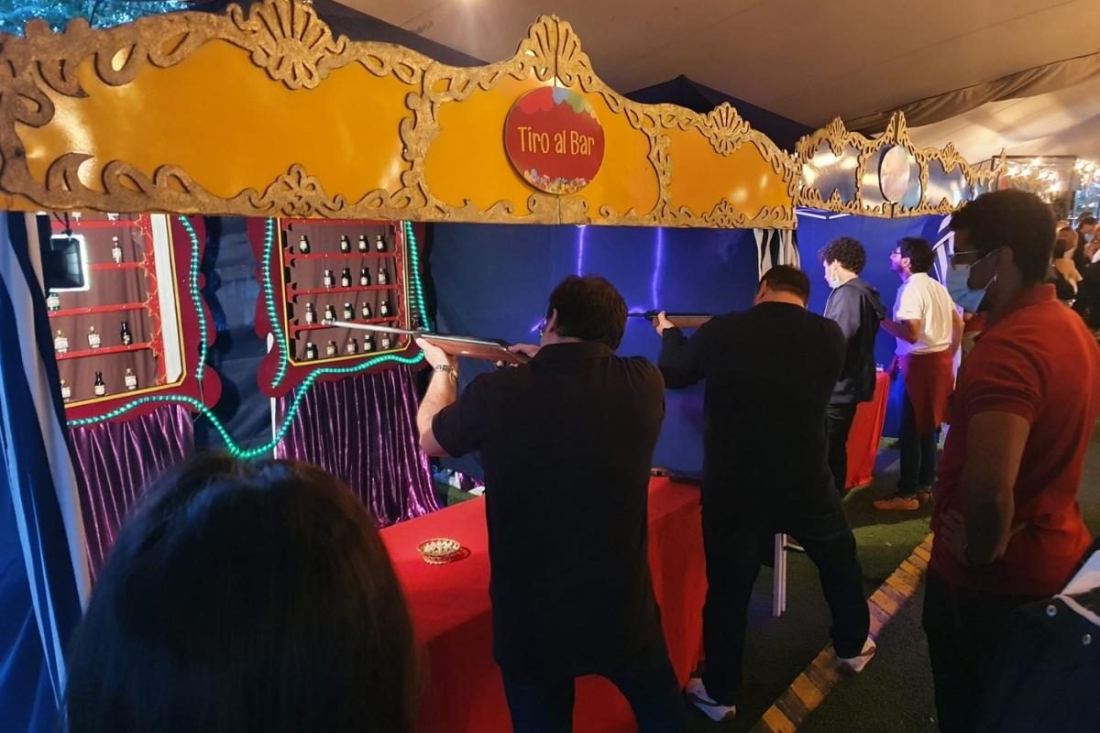
Organizing a corporate convention with hundreds of people is a logistical exercise every bit as demanding as the event content itself. Once headcount passes a hundred attendees, many of the team building activities that work perfectly for a team of twelve start to fall apart: someone never gets a turn to speak, groups lose focus, the sound doesn't carry, and half the room ends up staring at their phone. The challenge isn't just "running an activity" — it's designing an experience that scales without losing what makes team building work in the first place: getting people to take part, move around, laugh, and end up talking to colleagues they'd normally never exchange a word with.
At an event for 50 people, splitting into four or five teams and letting the dynamic flow organically is enough. At a 500-person kickoff, that approach collapses. You need more facilitators, materials logistics multiplied many times over, a scoring system that can be tracked on a big screen, and above all, activities designed from the ground up to run in parallel across many subgroups at once. The key is choosing modular formats: a shared structure that gets replicated across dozens of tables or zones simultaneously, tied together by a common thread and a joint closing moment that brings the whole group back together.
Venue is another decisive factor. Large conventions are usually held in convention centres, hotels with modular function rooms, or spacious outdoor areas, and the activity needs to adapt to that geometry rather than fight it. A gymkhana with challenges spread across different rooms or zones of the venue, for example, naturally solves the crowding problem: instead of a thousand people competing in the same spot, the group is spread out and the pace stays steady throughout the day.
Not every activity is built for mass groups, but some are designed with exactly that in mind. These are the ones that work best when attendee numbers climb:
When a company organizes a large convention, it's common to chop the programme into disconnected blocks: a talk, lunch, an activity, dinner. Team building works better when it's woven into the event's overall narrative rather than dropped in as an isolated interlude. If the convention has a central message —launching a new strategy, marking an anniversary, presenting results— the activity should reinforce that message, not compete with it. A themed gymkhana tied to the company's values communicates far more than the same gymkhana with no storyline behind it.
This matters even more at conventions bringing together people from different countries, departments or hierarchy levels who rarely cross paths day to day. The team building activity is, in many cases, the only moment in the whole event where a department head and a junior technician end up on the same team as equals. Building the groups deliberately —mixing departments, offices and seniority— multiplies the real value of the exercise, compared with leaving it to whoever happens to be sitting nearby.
With large groups, logistical details that go unnoticed at a small event become the very factor that decides whether the activity succeeds or fails. Some points worth checking well in advance:
Working with a specialist company that has already run conventions of this size massively cuts the risk. Improvising a table game for 30 people is one thing; coordinating a team of facilitators, materials and timing for several hundred participants spread across different areas of the venue is quite another.
Conventions tend to be long days, with business content in the morning and team building in the afternoon, or the other way round. The group's energy level isn't constant: after several hours of talks, attention drops and bodies start craving movement. That's why the most physical, participatory activities should sit at the lowest-energy points of the programme, saving the more reflective or emotionally-driven closing formats for the end of the day.
Activities like a haka or a batucada drum session work very well as a mid-day "reset": in just twenty minutes, they pull a scattered group back together, get everyone active again, and provide enough adrenaline to carry the rest of the programme. For the closing moment, formats with a celebratory feel — a verbena-style party or a final show involving every team — leave a positive memory that each attendee carries back to their desk.
After a large convention, many companies simply send out a standard satisfaction survey that barely captures any nuance. It's more useful to look at concrete indicators: how many people from different departments kept interacting in the days after the event, whether informal collaborations sprang up that didn't exist before, or whether the tone of subsequent internal meetings shifted. Team building at large-scale conventions isn't chasing an immediate, measurable result — it's planting relationships that later translate into a smoother way of working.
Where the convention is held has a big influence on what type of activity makes sense. An event at a trade fair venue in Madrid allows for large-format outdoor gymkhanas, while a convention at a hotel in central Barcelona may call for more compact formats suited to indoor function rooms. Working with providers who know each city well —and who have already worked in Madrid, Barcelona, Valencia or Seville— makes it far easier to adapt the programme to each venue's quirks and avoids last-minute surprises.
At large conventions, middle managers play a role that's often undervalued: they know their teams best and can anticipate whether a particular activity will land well with their people or fall flat. Involving them in designing the activity, even briefly, brings valuable insight that the organizing department doesn't always have from the outside. What's more, when a middle manager has had a say in the decision, they tend to engage far more on the day, encouraging their team to actively join in rather than standing back and watching from a distance.
Conventions held by large companies often bring together people from different international offices, which adds another layer of complexity: differences in language, culture and familiarity with this kind of activity. Choosing activities with a visual, intuitive mechanic that don't rely too heavily on spoken or written instructions in a single language makes it much easier for international teams to take part. Physical, rhythm-based activities — a batucada or a group choreography — tend to work especially well in these settings, because the language barrier practically disappears.
Designing team building for a large convention isn't a matter of multiplying an activity built for a small team by ten — it means rethinking the format from scratch with scale, logistics and the event's message in mind. The earlier specialists are brought into the planning —ideally at the same stage the content agenda is being finalized—, the more room there is to tailor the proposal to the venue, the budget and the company's specific objectives. If you're not sure which format best suits your convention, the most practical step is to talk directly with a specialist team who can assess attendee numbers, venue and programme timing before proposing a final solution.
We design the activity around your company and send a no-obligation quote within 24 hours. Here are some of the most popular:
Event
Why starting a launch with a team building activity builds more commitment than an email or a slide-…
Read more Event
Event
How to use team building dynamics at networking events to break the ice between people from differen…
Read more Event
Event
Ideas and tips for celebrating your company anniversary by combining recognition, history and a memo…
Read more