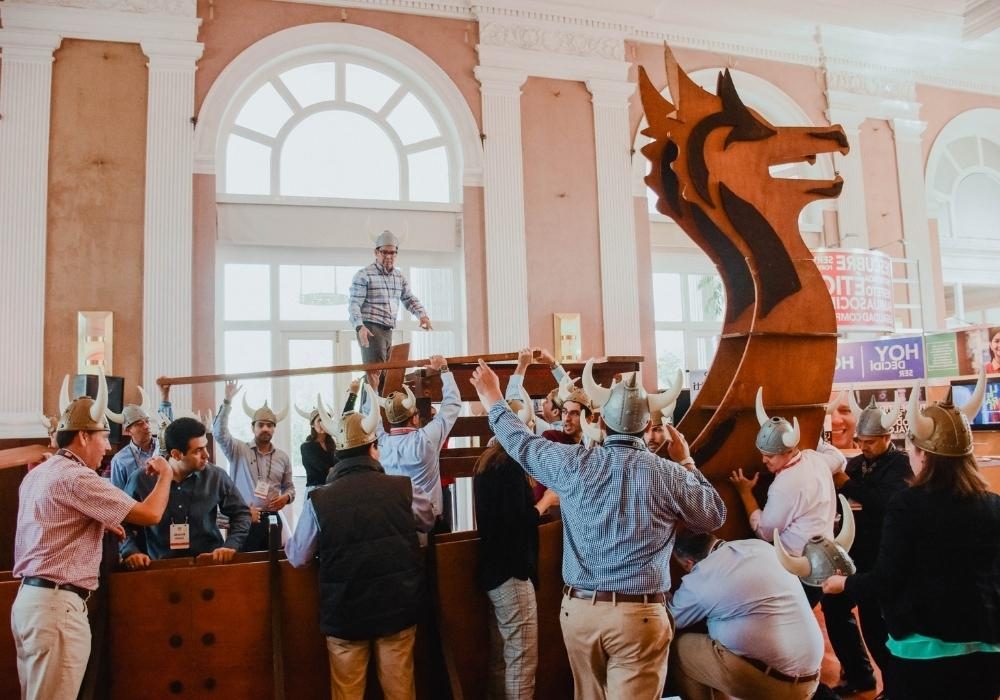
Some team building activities can be explained in a sentence, and others you have to see to believe. The Viking Ship belongs to the second group. Picture a hundred people walking into a hall with no real idea of what they are about to do and, a couple of hours later, standing next to a wooden ship fourteen metres long that they have raised together. It is a powerful image, but what matters happens beforehand: how they share out the work, who dares to coordinate, what happens when something doesn't fit, and how it gets sorted out.
In this article we explain how the activity works, what it includes, what space it needs, what it really develops in a group and what kinds of events it suits best. It is one of Kaizen's flagship activities, and it is worth understanding it well before deciding whether it is the right one for your team.
What the Viking Ship is
It is a playful, hands-on activity: participants build a Viking ship together from more than 800 pieces of wood. The finished result is 14 metres long and 6 metres high, and weighs more than 1,500 kilos. This is not a tabletop puzzle, but a large, highly visible structure, the kind people photograph and remember.
The idea behind it is a metaphor every company will recognise: we are all in the same boat. If part of the team doesn't do its job, the whole thing feels it. If two groups work without talking to each other, the pieces don't fit. And if nobody leads, time runs out. The activity presents those everyday organisational problems (changes of strategy, time management, leadership, communication) as a fun challenge, which is why the conversations afterwards tend to start by themselves: "this is exactly what happens to us at work".
Kaizen approaches it through what it calls accelerated learning: learning by doing, in a short space of time and in a playful atmosphere, instead of listening to a talk. What each person takes away depends on what they experience during the build, not on what they are told.
How the activity unfolds
Every event is tailored to the group, but the general sequence is as follows:
- Welcome with music and warm-up. Participants walk into a lively atmosphere, with short activities that release tension and create a good mood from the very first minute. It seems like a minor part, but it isn't: a group that arrives cold works less well.
- Forming the teams. They can be formed at random or according to whatever criteria the company sets (mixing departments, separating managers and their reports, balancing profiles). This decision matters more than it seems; we share a few ideas further down.
- Explaining the challenge. The instructors give clear guidance on how the ship will be built. Each team is responsible for raising a specific part of the structure, so the final success depends on every part being well made and ready on time.
- The build. This is the heart of the activity. Teams have to plan, share out tasks, communicate with the other teams and adapt when conditions change. There is time pressure, there are changes of strategy and, above all, a great need to reach agreement.
- The finished ship. The moment of seeing the complete structure is usually the most emotional. The group photo is taken, and it is the best starting point for a short closing conversation about what has happened.
The activity lasts between two and four hours, depending on the size of the group and whether it is combined with other activities or a meal afterwards.
Who leads it and what is included
This is not an activity that can be improvised or that runs itself. According to Kaizen's activity sheet, the service includes instructors who guide the challenge, referees or judges who make sure the rules are respected, a sports commentator who brings pace and atmosphere, and the materials for the challenges, that is, the pieces of the ship and everything needed to assemble them. The venue is an extra, either booked separately or provided by the client (a hotel hall, an open esplanade, the company's own premises).
The role of whoever leads the activity is more important than it seems: they keep up the pace, answer questions, make sure nobody is left out and ensure the game is fair when teams are competing. If you would like to know how to assess a company before hiring it, we have an article on how to choose the right team building company.
What it really develops in a team
The list of benefits usually associated with the Viking Ship is long (results-focused work, problem solving, planning, communication, leadership, integration, a sense of belonging), but it helps to bring it down to earth. These are the things you actually see in the room:
- Dividing up tasks. A ship this size can't be built well if everyone does the same thing at once. Teams that get organised early tend to move forward more smoothly. And that division of labour, which sometimes happens by itself and sometimes takes negotiation, is a fairly faithful mirror of how the group works day to day.
- Leadership that emerges on its own. In every team someone steps up to coordinate, even if they don't hold the highest position. Watching this is very revealing for whoever manages the group. In fact, it is a good argument for managers to take part like everyone else rather than watching from the edge of the room.
- Communication between teams. Because each group raises one part, the pieces have to fit with those of the others. Anyone who doesn't ask questions or share information pays for it in the end.
- Managing time and change. The changes of strategy the activity introduces force teams to replan on the fly. It is light training for something that happens in any real project.
- Shared pride. Seeing the finished ship creates a feeling of collective achievement that few meetings manage to match. That image becomes a shared memory and a story the team keeps retelling for months.
If you are worried that the effect will fade by the following week, it helps a great deal to prepare the team beforehand and revisit the experience afterwards; in how to prepare your team before a team building we explain how to do it, and in how to measure the return on a team building you will find ideas for checking whether it has worked.
Space and logistics: what to know before booking
A 14-metre ship needs room. The activity can be run indoors or outdoors, and the activity sheet mentions gardens, esplanades and covered halls. For a covered space, the stated minimum is 5 metres in height by 4 metres in width. Before fixing a date, it is worth confirming the following with whoever manages the venue:
- Real usable height of the hall, once you discount lamps, beams or any hanging fixtures.
- Access and loading. The pieces and materials have to get into the venue; ask about doors, goods lifts and set-up times.
- Floor and surface. Outdoors, reasonably flat, clear ground makes the activity simpler.
- A weather Plan B. If you run it in the open air, have a covered alternative ready in case of rain or wind. It is the kind of decision you will be glad to have made weeks in advance.
- Set-up and take-down time. The day of the event doesn't begin when participants arrive, but before, and it ends after they have left.
For more criteria on choosing the venue, you can read how to choose the perfect location for your team building, and if you are torn between outdoors and indoors, our guides to outdoor team building and indoor activities will help you decide.
How many people can take part
One of the advantages of the Viking Ship is its scale: the activity sheet speaks of groups from 30 up to 400 people at once. Beyond a certain size, the usual approach is to split the group into more teams and more sections of the ship, with more instructors to support them. That makes it one of the few activities that genuinely work at a convention, an annual meeting or an event with the whole workforce, where other proposals fall short.
The activity sheet starts at around 30 people, which makes sense when a structure like this has to be raised by everyone together. If your group is smaller, there are activities designed for that; here are 15 team building ideas for small groups.
What kind of event it suits best
- Conventions and annual meetings. It is a way of breaking up the routine of seated sessions and getting people from different areas to work together. We have a guide to team building activities for large conventions with more ideas along these lines.
- Start of the year or of a project. To align the team around a shared goal and start with energy.
- Integration after a change. When new teams come together or there is a reorganisation, building something physical together works better than a talk. More in team building for mergers and acquisitions.
- Events with lots of people. Among the 20 team building ideas for large company events there are other alternatives to compare it with.
Tips for getting the most out of it
- Have management genuinely take part. If the leaders work in a team like everyone else, the rest relax. If they watch from outside, the activity turns into an exam.
- Mix departments. The ship is a great excuse for people who hardly ever cross paths to get to know each other. If you let each group stick with its own colleagues, you waste the best part of the activity.
- Define an objective. Do you want cohesion, communication between areas, a celebration? The clearer you are about it, the easier it will be for whoever leads the activity to focus the messages.
- Give a heads-up about the basics. Let people know it will be a group activity, with movement, and that they should come in comfortable clothes and shoes. There is no need to reveal more.
- Close with a short conversation. Five or ten minutes to discuss what happened, what was learned and how it can be carried over to work make the difference between a pleasant time and an experience that leaves a mark.
- Be realistic about the logistics. Budget, transport, food and venue add up to more than they seem; in how much a team building costs there is a guide to the factors that affect the price.
Viking Ship compared with other activities
If you are still comparing options, here are a few useful differences. The Viking Ship is a building and collaboration activity: all the teams work towards a common goal and there is no single winner. Defuse the Bomb is more theatrical and is played against the clock, with a story that surprises the participants. The paella contest is cooking as a team, more relaxed and with a result that is shared at the table. And if you want a more competitive option, there are mini Olympics formats. To help you decide between competing and collaborating, our article on competitive versus collaborative team building may help.
Frequently asked questions
Is physical effort required?
There is movement and manual work, as you would expect when building a structure this size, and it is designed for company groups. It is best to mention when organising the activity if any participants have limited mobility, so that they can take part in coordination, planning or support roles.
Can it be done indoors?
Yes, as long as the hall meets the height and floor-space requirements. Both indoor and outdoor venues are possible; what matters is confirming the measurements in advance.
How long does it last?
Between two and four hours, depending on the number of participants and the format designed for your event.
Are there winners?
The activity is about building something together. The aim is to complete the ship, and the final takeaway has more to do with how well people collaborated than with who won.
In summary
The Viking Ship works because it makes tangible something that is so hard to see in an office: that each person's work depends on everyone else's. It is a highly visual activity, suitable for large groups, that requires a suitable space and some preparation, and that leaves a shared memory hard to match with a meeting. If you would like more details, photos and the full activity sheet, you will find them on the Viking Ship activity page. And if you would like us to help you judge whether it fits your team and your date, tell us what you need and we will suggest options.

 Company Activities


