 Teamwork
Intergenerational Team Building: How to Bring Every Generation in Your Team Together
How to design team building activities that connect Baby Boomers, Generation X, Millennials and Gene…
Read more
Teamwork
Some teams have worked together for years and yet still communicate cautiously, avoid asking for help, or hold back an opinion for fear of how it will land. Other teams, young and newly formed, reach in a matter of months a level of understanding that seems impossible to improvise. The difference is almost never how much the people involved like each other. It's trust. And unlike liking someone, trust doesn't appear on its own: it's built through shared experiences that test something real, even on a small scale. That's where activities to build trust within a team come in — designed specifically for that purpose, not as a simple add-on to a day of corporate leisure.
No team leader can order their people to trust one another. Trust isn't an instruction, it's a consequence. It forms when one person sees firsthand that another responds well when needed: keeps their word, doesn't take advantage of someone else's vulnerability to look better, supports a colleague through an uncomfortable moment instead of leaving them to face it alone. The problem is that, in everyday office life, these situations are rare and usually shaped by hierarchy, time pressure, or the fear of making a mistake in front of others.
Well-designed team building dynamics compress that process. In a safe space, away from the usual work context, they create small situations of controlled risk in which people have to rely on one another to reach a goal. There are no performance reviews involved, no boss watching the clock — just a shared challenge. That combination of psychological safety and real challenge is exactly the ground where trust takes root.
When trust between colleagues is low, the cost doesn't show up in any single metric, but it shows up in everything: longer meetings because no one wants to make a decision without covering themselves first, emails copied to half the company to spread out responsibility, ideas left unsaid for fear of looking foolish, tasks reviewed over and over because no one trusts a colleague's work. It's an invisible tax that slows down every project and, over time, wears down the most committed people — precisely those who suffer most from the lack of an environment where they can let their guard down.
Not every activity works equally well for this purpose. A purely competitive gymkhana can strengthen group cohesion, but not necessarily interpersonal trust, if winning matters more than looking out for one another. To work on trust specifically, it's worth choosing activities that, one way or another, force people to depend on each other.
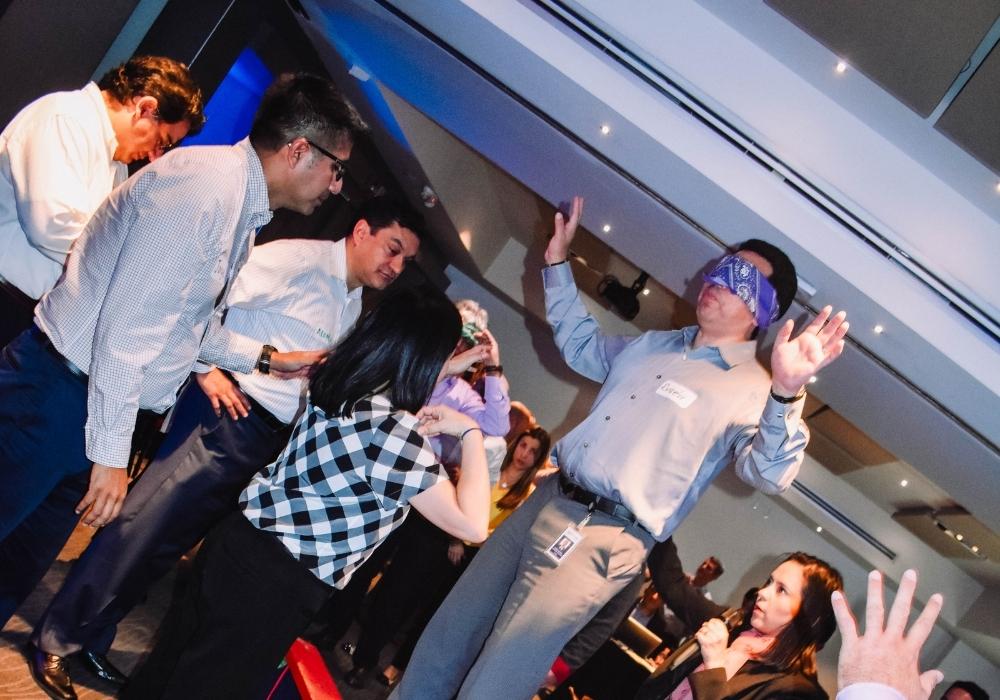
The classic trust-fall exercises, or guiding a blindfolded colleague, still work because they tap into something very basic: giving up control. When someone lets themselves fall knowing another person will catch them, or walks blind trusting a colleague's directions, they're making a conscious decision to be vulnerable. And when that trust is met, the bond it creates runs far deeper than any team talk or informal lunch could achieve. Activities like a survival course take this idea into a natural setting, where participants depend literally on group cooperation to solve practical challenges.
Another powerful format is challenges where only part of the team has the information needed to move forward, and the rest must be guided by what their colleagues tell them without being able to verify it. A bomb defusal exercise, for example, forces a group to listen closely, communicate precisely under time pressure, and trust that the person holding the information is doing their part well. That kind of controlled tension, with no real consequences if something goes wrong, is excellent training for operational trust — the kind you need when you delegate a task and can't oversee it step by step.
Some activities demand physical coordination and shared responsibility to reach a tangible goal, such as building a structure, crossing an obstacle, or completing a course as a team. Activities like bridge to the future put people in a position where they're literally holding up the group's progress, which translates very directly into the idea that the outcome depends on everyone doing their part and trusting that others will do theirs.
Not everything has to be physical. Some of the dynamics with the greatest long-term impact on trust are those that invite people to share something personal: a difficulty they overcame, a lesson they learned, honest recognition for a colleague. These moments work best when introduced gently, after an activity that has already built some closeness, and never as an imposed exercise in emotional exposure. The key is letting each person decide how much they want to share — trust is also built by respecting each individual's limits.
Building trust in a newly formed team is not the same as building it in one with accumulated tension or a history of unresolved conflict. Before booking an activity, it's worth asking a few questions:
These answers help decide whether to start with something lighter, like a fun icebreaker, or whether the team is already ready for a challenge that demands greater emotional involvement. A good team building provider should be able to adapt their proposal to this initial assessment, rather than always offering the same fixed catalogue.
Choosing an activity labelled "trust-building" doesn't guarantee the effect on its own. There are several mistakes that can turn a good idea into a counterproductive experience.
Forcing someone into a physical or emotional exercise they're not comfortable with produces the opposite of the intended effect: instead of trust, it leaves a feeling of exposure and loss of control over one's own situation. There should always be another way to take part, without singling out anyone who chooses not to do it.
Finishing the activity and moving straight on to the next item on the agenda wastes a large part of the learning. A short space to talk about how everyone felt, what worked, and what was harder, helps turn the experience into a conscious conversation about how the team works together, not just a good memory.
The trust built in a single afternoon doesn't hold up on its own if everything stays the same back at the office: the same meetings where no one speaks up, the same lack of recognition, the same uncomfortable silences. Team building is a boost, not a definitive solution.
The real challenge starts the next day. To stop the effect from fading, it helps to translate the experience into concrete habits: publicly recognising colleagues' successes just as was done during the activity, keeping short, regular spaces to talk about how the team is doing beyond the task list, and allowing those who lead to show some vulnerability too, because trust spreads from the top down far more powerfully than the other way around.
No team building activity can, on its own, make up for a leadership style that punishes mistakes or hands out recognition unfairly. When the person leading a team takes part in the activities with the same willingness to get things wrong that they ask of everyone else, it sends a far more powerful message than any speech about the importance of trust. If, instead, they simply watch from the sidelines or use the activity as one more opportunity to assess their team's performance, whatever distrust already existed will be reinforced rather than reduced. That's why it's also worth briefing managers before the day, reminding them that their role there is to be just another participant, not a supervisor with a notepad in hand.
The trust generated on an afternoon of activities is sustained by everyday gestures that cost little but mean a lot: explicitly thanking someone when they deliver on a promise, admitting your own mistake in front of the team without making a drama of it, asking for help when you genuinely need it instead of pretending everything is under control. Repeated consistently, these behaviours do far more for long-term trust than any single event, however well designed.
It's useful to know how to spot signs that the work is paying off, even though there's no exact metric for it. Common indicators include meetings getting shorter because decisions are made more quickly, people starting to ask for help openly instead of trying to solve everything alone, differing opinions being shared without fear of how the group will react, and mistakes being reported early rather than hidden until they become a bigger problem. None of these signs appears overnight, but all of them are more likely once a team has experienced, even just once, what it means to depend on someone else and find that trust was well placed.
If your team needs a clear starting point to build genuine trust, get in touch and we can help you design a day tailored to your specific situation. And if you have questions about how these dynamics work, check out our team building FAQ before deciding.
We design the activity around your company and send a no-obligation quote within 24 hours. Here are some of the most popular:
Teamwork
How to design team building activities that connect Baby Boomers, Generation X, Millennials and Gene…
Read more Teamwork
When a startup grows very fast, its culture takes a hit. Find out how team building helps keep your …
Read more Teamwork
How to design team building activities that work across teams with multiple languages and cultures, …
Read more