 Company Activities
Team Building for Logistics and Warehouse Teams: How to Get It Right
Why warehouse and logistics teams almost never get team building, and which formats really work with…
Read more
Company Activities
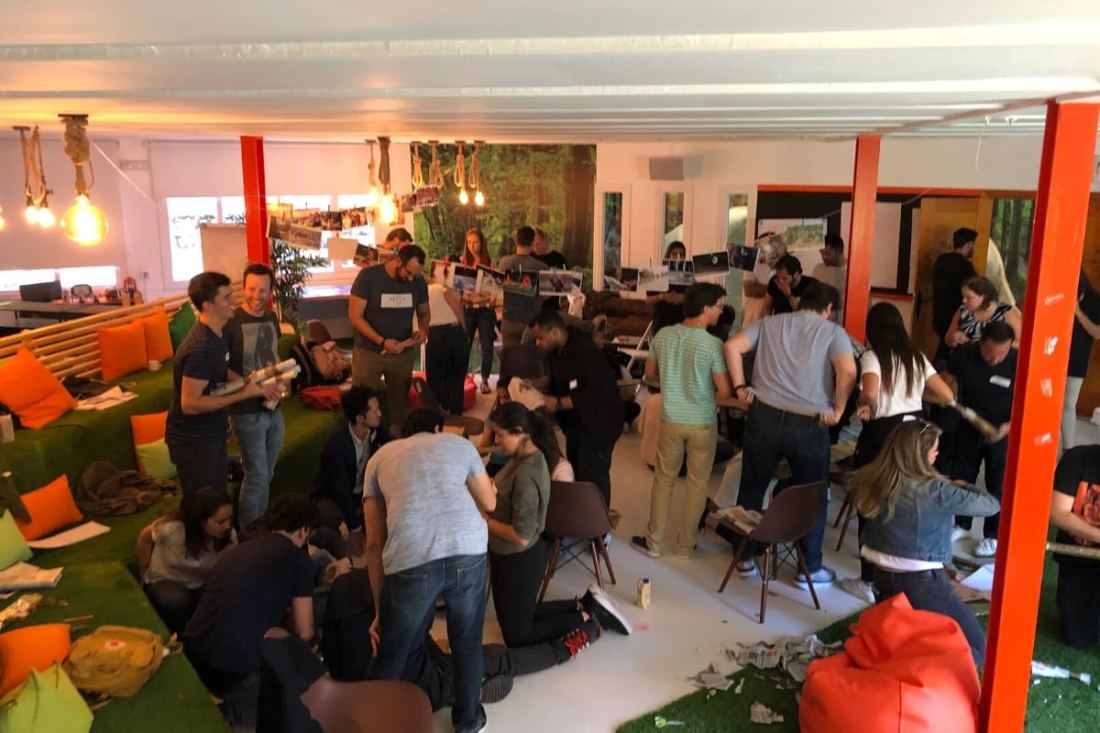
Healthcare staff spend their working day supporting other people at their most vulnerable. Nurses, care assistants, doctors, hospital porters, emergency department staff, care homes and private clinics all share something that is rarely mentioned in management meetings: the accumulated toll of working under pressure, on rotating shifts, making decisions that leave no room for error. When a healthcare organisation considers team building, it is not looking for just another social afternoon. It is looking for a space where that toll can be eased, even for a few hours, and where the team can reconnect away from the ward corridor, the consulting room or the operating theatre.
This article explores why healthcare is precisely one of the sectors that can get the most out of a well-designed team building activity, and what you need to bear in mind to make it work properly: from timing to the type of activity, including how to involve very different profiles within the same team.
Working in healthcare means living with urgency as an almost permanent state. We are not talking only about emergency departments in the strict sense: a primary care surgery with an overflowing appointment book, a hospital ward with too few hands for too many patients or a dental clinic with a full diary all generate a very similar kind of sustained tension. On top of that clinical pressure comes the emotional weight of dealing with sick people, anxious families and, at times, difficult news that has to be delivered with care and composure.
The result is teams that function well but barely have the chance to get to know one another beyond the task in hand. Colleagues on the same shift cross paths, coordinate, cover for each other... and often say goodbye without having talked about anything other than work. That lack of informal connection is not a nice-to-have: it directly affects how a team holds up in the medium term, how it copes with peaks in demand and how each person recovers between shifts.
In any company, a cohesive team communicates better, resolves conflicts faster and copes better with peaks in demand. In a healthcare setting these effects are even more noticeable, because the margin for error is smaller and coordination between different profiles (nursing, medical, administrative, porters, cleaning and maintenance staff) is constant and critical to the running of the service.
A team that knows each other outside the clinical setting tends to understand each other better within it. When someone has spent a relaxed afternoon with a colleague, it feels more natural to ask them for help at a difficult moment, to let them know something is wrong or simply to ask how their week is going. That kind of relationship does not replace technical training or internal protocols, but it does build the human foundation on which those protocols work better in day-to-day practice.
Recognition matters too, and people notice it. Organising an activity designed specifically for the healthcare team sends a message that goes beyond the leisure event itself: management understands what this work demands and is willing to invest time and resources in looking after those who look after others, rather than taking it for granted.
Not every team building format suits a healthcare team equally well. Several factors make the difference between an activity that is remembered fondly and one that feels like one more obligation added to an already overloaded schedule.
The biggest logistical challenge of organising team building in healthcare is not the activity itself, but fitting it around a shift system that never stops. A hospital, health centre or care home cannot be left without cover, so it is rarely possible to bring the whole team together at once. The options that tend to work best are repeating the same activity across several sessions so that everyone can take part at some point, choosing a quieter period of clinical activity within the centre, or building the activity into a training day or conference that is already planned, so that nobody loses any rest time.
Whichever approach you choose, it is worth involving shift managers from the very beginning. They know the real gaps in the schedule best, and they can tell you whether a particular date is likely to clash with a vaccination campaign, a seasonal flu peak or a holiday period.
After long shifts, often spent on your feet and physically demanding throughout, the last thing anyone wants is an activity that means more wear and tear on the body. That is why healthcare teams tend to respond better to proposals that prioritise mental switch-off and emotional connection over intense physical effort: creative, culinary, musical or relaxation workshops, rather than demanding sporting contests that add fatigue instead of taking it away.
This does not mean giving up on fun or on the group's energy: it means choosing the right format. A laughter therapy session, for example, is a particularly good fit because it offers exactly the opposite of what the team experiences day to day: explicit permission to laugh, release tension and not take anything too seriously for a while. A yoga workshop or breathing session serves a similar purpose through calm, something especially valued by people who spend the day managing other people's stress and distress.
A healthcare team brings together very different profiles in terms of age, physical condition and responsibility: a thirty-year-old porter is not the same as a nurse with mobility problems, and a consultant is not the same as a newly hired care assistant on a temporary contract. A good team building activity for this sector has to be equally enjoyable whatever a person's physical condition, without demanding a particular level of fitness or putting anyone on the spot in front of their colleagues. Activities based on creativity, the table, the kitchen or music tend to solve this naturally, because each person's level of participation adapts without feeling forced or awkward.
This is not meant to be a closed list, but these are some of the activities that, by format and pace, tend to suit the needs of a healthcare team particularly well:
They all have something important in common: none requires prior physical preparation, they can all be adapted to indoor spaces, and they can be repeated across different shifts without any group feeling at a disadvantage compared with another.
Beyond choosing the right activity, the key to success lies in planning ahead. It is worth starting by talking to whoever manages the shift rotas, not just the HR department, to understand the centre's real availability. It also helps to approach the activity as something recurring rather than a one-off event: a short session every few months tends to build more connection over the course of the year than a single big annual day that is hard to fit into everyone's calendar.
Another point to watch is communication with the team beforehand. Healthcare staff are used to being asked for things at the last minute; announcing the activity well in advance, explaining what it involves and making it clear that nobody is penalised for being unable to attend because of their shifts helps the proposal come across as a gift rather than an extra burden on the diary.
If the organisation has sites or centres in different cities, it is also worth considering local options close to each centre. Cutting down on travel makes the logistics much easier for staff who already have enough to deal with in their own shifts and usual commutes, and it increases the real likelihood that the whole team can take part in at least one of the scheduled sessions.
It is hard to put an exact figure on the effect of an afternoon of team building on a healthcare team's morale, and it would be dishonest to invent a percentage just to sound convincing. What we can say, because the teams that take part tell us time and again, is that these activities offer something that day-to-day clinical work rarely allows: shared time without urgency, without patients in the middle and without the professional label coming first in every interaction. That time, however brief, leaves its mark on how a team relates to one another for the rest of the year, in the corridors and in the difficult moments.
Looking after those who look after others is not just a nice phrase for a corporate social responsibility report. It is a management decision with concrete effects on staff retention, the working atmosphere and the quality of care that a slightly more rested and connected team can then offer its patients. If you would like to design an activity around the real shifts and needs of your healthcare team, our team can help you fit it into your calendar without compromising patient care. You can also check the team building FAQs if this is the first time you are organising an activity of this kind for your centre.
We design the activity around your company and send a no-obligation quote within 24 hours. Here are some of the most popular:
Company Activities
Why warehouse and logistics teams almost never get team building, and which formats really work with…
Read more Company Activities
Incentives and team building are not the same thing: one rewards individual results, the other stren…
Read more Company Activities
Find out why marketing teams need a different kind of team building, and which activities work best …
Read more