 Company Activities
Team Building for Logistics and Warehouse Teams: How to Get It Right
Why warehouse and logistics teams almost never get team building, and which formats really work with…
Read more
Company Activities
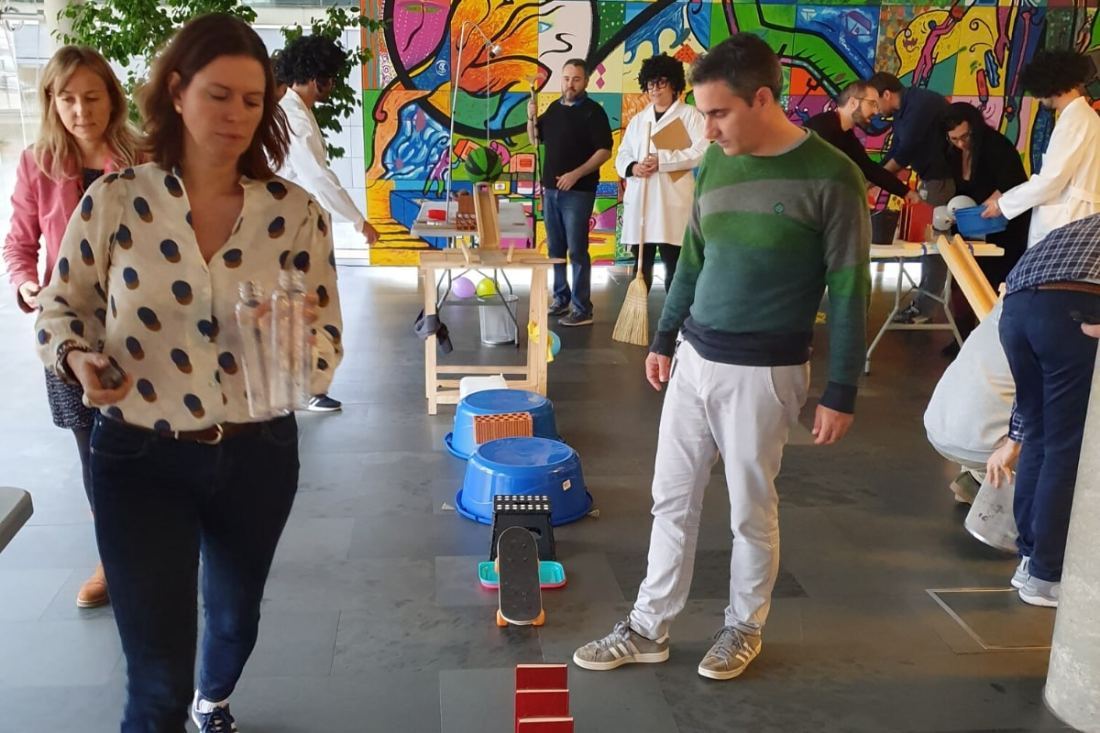
Marketing teams live with a paradox: they have to come up with fresh ideas every single day, against relentless deadlines and in an environment where the rules keep changing. Today it is a social media campaign, tomorrow a product launch, the day after a results report that should have been delivered yesterday. These are professionals used to creative pressure, and that is precisely why they need a different kind of team building from other departments. A generic trust exercise will not do. A marketing team appreciates activities that speak its language, that demand lateral thinking, that reward original ideas and that, along the way, offer a genuine break from the routine of briefs, editorial calendars and results meetings.
Every department benefits from activities that strengthen group cohesion, but marketing adds another layer worth considering: creativity is not a nice-to-have, it is the raw material the team works with every day. When a team is mentally drained from generating ideas for clients, for its own campaigns or for brand positioning, it needs activities that reactivate that capacity rather than demanding more of the same mental effort it already puts in during a normal working day.
Designers, copywriters, community managers, analytics specialists and brand managers share a department despite very different working rhythms, but they have one thing in common: the demand for creative results against a fixed delivery date. That constant tension between inspiration and deadline can wear a team down if it is not balanced by spaces where creativity can be exercised without the pressure of a final result for a client or for the business itself.
A marketing department is rarely homogeneous. Highly analytical profiles, focused on data, metrics and campaign performance, work alongside purely creative ones who think in images, copy and narratives. Good team building for marketing does not favour one profile over the other. It looks for activities where analytical and creative thinking need each other to solve the challenge at hand, just as happens in any real campaign that combines strategy and execution.
Not every team building activity works equally well with this kind of team. Before choosing one, it helps to be clear about exactly what you are looking for, because the objective determines the most suitable format.
Methodologies based on building and visual thinking work particularly well with these teams because they let people express abstract ideas in a tangible way. Lego® Serious Play® is a perfect example: it turns building bricks into a language for solving team problems, which is very close to how a marketing department builds a brand narrative piece by piece until it arrives at a coherent message. Participants do not just talk about ideas: they build them, hold them and defend them in front of everyone else, which forces a different way of thinking from the one used in front of a screen or a briefing document.
Few things connect with a marketing team like producing something with a visible end result, just as with a complete campaign. Activities such as a percussion and batucada workshop work as a direct metaphor for creative teamwork: each person contributes a different rhythm, and the collective result only works if everyone listens to the rest, something any content manager will recognise immediately when coordinating disparate pieces within a single campaign.
Another option that teams used to producing audiovisual content value highly is a collaborative filming format such as a Lipdub, where the whole team takes part both in front of and behind the camera. It replicates, in a playful way, the full process of a marketing production: script, coordination, rehearsal and final delivery, with the advantage that here the only goal is to have fun and enjoy the result together.
Marketing teams often really enjoy activities that combine technology, clues and teamwork under time pressure, because they recreate, without any real stress, the feeling of getting a campaign out at the last minute. A tablet-based gymkhana such as Cluetivity makes it possible to include challenges around creativity, communication and strategy, all in an agile, visual format that connects naturally with the digital profile of these teams and with their usual way of working through challenges.
A marketing team can tell straight away when an activity has been poorly conceived, precisely because their job is to design experiences for other people. That is why it pays to take care of the same details they would take care of in any campaign of their own: a good presentation of the challenge, a clear brief with room for interpretation, and a close that recognises the result of each team or person, just as you would celebrate the launch of a campaign that has performed well.
It also helps a great deal to connect the activity with the identity of the brand or the department. The activity does not need to be literally about the company, but the tone, the humour and the level of creativity required should be aligned with the team's culture. A marketing department with a relaxed brand tone will enjoy an activity with the spirit of a show far more, while a more institutional one may prefer a challenge centred on strategy and idea-building rather than staging.
A marketing department's calendar is not uniform: there are very busy periods, such as the close of a campaign for an important commercial date, and quieter ones when the team can breathe with a little more room. Scheduling team building right after an intense peak of work tends to work especially well, because the activity is seen as a well-earned reward for recent effort rather than an interruption at a critical moment of production. Choosing the wrong moment, on the other hand, can have the opposite effect: a team that arrives thinking about everything still pending will not enjoy it as much, however well designed the activity is.
It is also best not to make team building so frequent that it loses its special character, nor so infrequent that the team sees it as something exceptional and disconnected from the company's everyday culture. Finding a sensible rhythm, with one or two major events a year and a few more informal get-togethers in between, is usually the formula that works best for marketing departments used to working in campaign cycles.
One detail that is often overlooked is the role the head of the department should take during the activity. If a marketing director spends the day glued to their phone or supervising from the sidelines, the rest of the team picks up on that distance immediately and participates with less commitment. When leaders, on the other hand, get involved as just another member of the challenge, setting aside their hierarchical role for those few hours, the activity gains in authenticity and the team reads it as a real sign of closeness, not just a symbolic gesture organised by HR.
When the activity genuinely connects with the team's profile, the effect goes beyond the day itself. A marketing department that has shared a creative experience outside its usual work context tends to return to the office more at ease proposing ideas in meetings, more confident defending them in front of the rest of the team, and with a smoother relationship between creative and analytical profiles, who do not always get the chance to collaborate so directly in everyday work, without a client waiting for results.
At Kaizen Team Building we design each activity around the team that will experience it, adapting the challenge, the tone and the duration to the specific profile of the marketing department we are working with. If you would like to review the full catalogue of available activities, you can visit our team building page, and if you would prefer us to help you design a proposal tailored to your team, you can get in touch with us and we will support you from the initial idea right through to the day of the event.
We design the activity around your company and send a no-obligation quote within 24 hours. Here are some of the most popular:
Company Activities
Why warehouse and logistics teams almost never get team building, and which formats really work with…
Read more Company Activities
Why healthcare staff need team building that fits around their shifts, and how to design inclusive, …
Read more Company Activities
Incentives and team building are not the same thing: one rewards individual results, the other stren…
Read more