 Teamwork
Intergenerational Team Building: How to Bring Every Generation in Your Team Together
How to design team building activities that connect Baby Boomers, Generation X, Millennials and Gene…
Read more
Teamwork
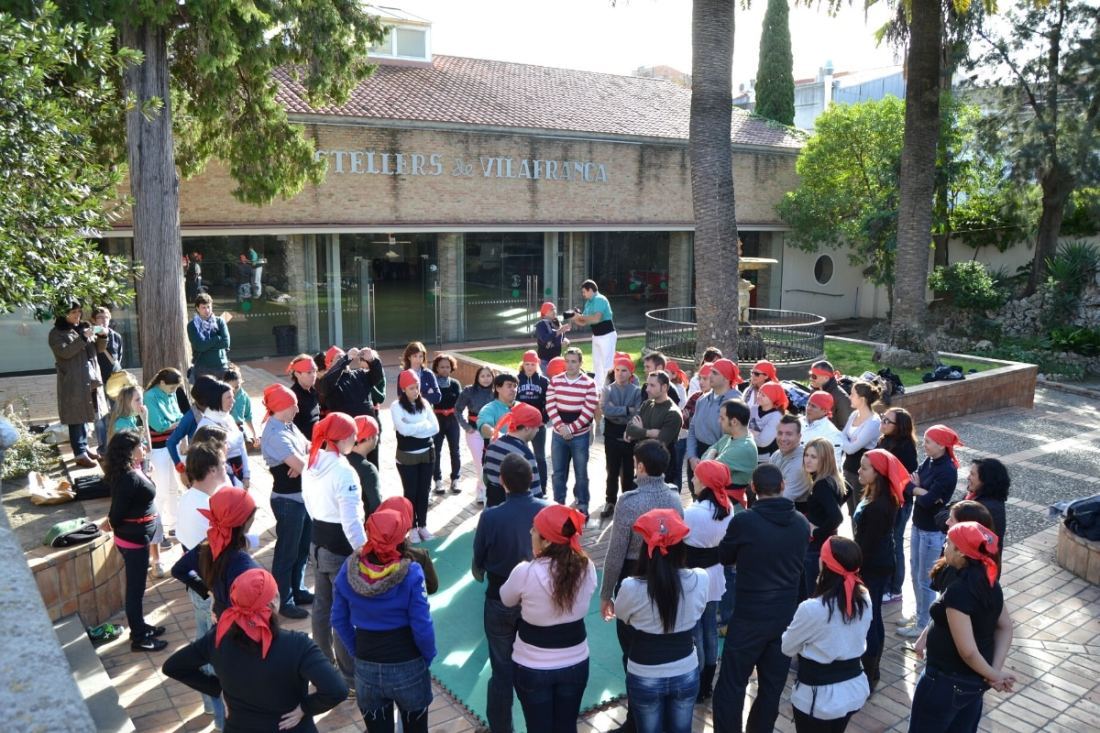
When a startup goes from ten people to forty in less than a year, something almost always breaks along the way: the feeling that we are all part of the same project. It is not a talent problem, nor a case of company culture being poorly defined in some nicely written internal management document; it is a problem of time and human contact. In a startup growing at full speed, people simply never get the chance to get to know each other. And that is where team building for startups stops being an HR nice-to-have and becomes a tool for organisational survival.
In large companies, culture is sustained by processes, manuals and well-oiled hierarchies. In a startup, culture is sustained by people who know each other, trust each other and understand why they do what they do. When a team doubles or triples in a few months, that web of trust does not grow at the same pace as the org chart. And if nobody does anything about it, the company ends up split into small islands: the founders and the first ten hires, the team that arrived with the first funding round, the salespeople who joined with the expansion, and the latest recruits who do not even know where the coffee machine is yet.
The startups that manage to scale well are not necessarily the ones with the best product, but the ones that keep their team rowing in the same direction even after it has multiplied in size. That sounds like a line from a management textbook, but it has a very concrete meaning in day-to-day work: meetings where people dare to disagree, teams that help each other across departments without it needing to be escalated to a manager, and a shared feeling that the company's success is also each person's own success.
All of that is built through human relationships, not through a well-organised internal communication tool. And human relationships need moments outside the purely work context: spaces where hierarchy fades a little, where the intern and the technical lead are on the same team trying to solve a challenge, and where conversations come up that would never happen in a progress meeting.
A common mistake in startups is to assume that the culture of the early months is passed on by itself, by osmosis, to those who join later. It is not. The culture of a small company lives in the heads of a few people; when the team grows, that culture has to be made explicit and lived together as a group, rather than assuming everyone will pick it up by watching how the founders behave in a meeting.
Many startups, when they finally decide to invest in team building, make the mistake of copying the big-company model: a spectacular annual event with speeches and a gala dinner. It is fine as a celebration, but it does not solve the real problem, which is the day-to-day fragmentation of the team across different stages of the company's life.
What works best in a fast-growth environment are activities that:
Activities such as Lego® Serious Play® are a particularly good fit in this context, because they force people to put ideas and visions of the project into words in a very visual, non-hierarchical way: everyone builds and explains, regardless of their job title or how long they have been with the company. It is a very honest way of bringing to the surface worries or hopes that, day to day, stay buried under the task at hand.
Before deciding which activity to run, it is worth diagnosing whether the problem really exists. Here are some fairly reliable signs that a growing team is breaking up into isolated subgroups:
None of these signs is serious on its own; they are quite normal in any growth process. The problem appears when they pile up and nobody does anything to correct them, because then they turn into real friction: less collaboration between areas, slower decisions and an atmosphere where it is harder to ask for help from someone you do not know.
Not every team building activity works equally well for a startup that is hiring every month. These are some of the ones that tend to deliver the best results precisely because they combine fun, team mixing and a genuine element of collaboration.
A gymkhana in digital format, such as Cluetivity, is especially comfortable for young, tech-savvy teams: mixed groups are formed, there are ingenuity challenges spread across different spaces, and the dynamism of the format itself gets people interacting with colleagues they would normally never exchange a word with in the office.
Formats like Squad Games, inspired by the team challenges popularised by certain TV formats, work very well because they create a very clear shared goal: winning the challenge requires the group to organise itself, listen and trust each member's strengths. It is exactly the kind of implicit learning a startup needs to carry over from the game into everyday work.
Not everything has to be adrenaline. When a team has been working at a very high pace for months, sometimes what is needed is exactly the opposite: slowing down. Yoga or laughter therapy sessions may seem a bit uncorporate at first glance, but they are often an excellent counterpoint for young teams that have spent months in maximum-demand mode and need a shared space that is about switching off together rather than pressure.
One of the biggest risks for a growing startup is that team activities end up reinforcing, unintentionally, the divide between "the old guard" and "the newcomers". If team building is always organised by the same people, with the same in-jokes and references that only the founders understand, the effect is the opposite of what was intended: new arrivals feel even more left out.
To avoid this, it helps to follow a few simple but very effective rules: form groups randomly or across teams, avoid having the same team make up the same group in consecutive activities, and give explicit prominence to those who have been with the company the shortest time, for example by letting them present their group's results at the end of the activity. They are small details, but they completely change the sense of belonging for someone who has been at the company for three weeks and still does not know half the names.
A common question among founders and people managers is the right frequency. In an established company, one event a year may be enough. In a startup that is hiring continuously, that pace falls short: each new wave of hires dilutes a little more of the cohesion achieved at the previous event.
An approach that tends to work better is to combine activities of different formats and frequencies: short, informal get-togethers on a regular basis, and one or two more elaborate events a year, coinciding for example with the close of a funding round, the achievement of an important milestone or, quite simply, the change of season, which is often a natural moment to pause and reconnect as a team.
A twelve-person startup that has just closed its first round is not the same as an eighty-person company spread across two offices. In the first stage, almost any activity that brings the whole team together somewhere other than the office already adds a lot of value, because the group is small and everyone knows each other, even if only superficially. At later stages, with larger and possibly distributed teams, it is worth thinking about activities that explicitly force mixing between departments and locations, and that leave enough time for informal conversation before and after the activity, which is often as valuable as the game itself.
If you are not sure which format best fits your company's current moment, the most practical thing is to put the challenge to us directly: tell us how many of you there are, how growth has looked over the past year and what exactly worries you about team cohesion. At our team we regularly help startups design the format that best suits their situation, rather than offering them a standard package that would work the same for any company. You can also check our frequently asked questions about team building if this is the first time you are organising an activity of this kind, or take a look at the full catalogue of activities to get an idea of the variety of formats available.
It is easy, in a startup's early years, to see any spending that is not directly product or sales as dispensable. But team cohesion is not an aesthetic luxury: it is what stops growth from turning into internal chaos, friction between departments or a higher talent turnover than the company can afford. Looking after how the team gets to know and relate to each other as it grows is, ultimately, looking after the company's ability to keep growing without breaking apart from the inside.
We design the activity around your company and send a no-obligation quote within 24 hours. Here are some of the most popular:
Teamwork
How to design team building activities that connect Baby Boomers, Generation X, Millennials and Gene…
Read more Teamwork
How to design team building activities that work across teams with multiple languages and cultures, …
Read more Teamwork
Discover which team building activities fit best with agile and Scrum teams, built around iteration …
Read more