 Team Building
Autumn team building: back-to-school activities for your company
September and October are the ideal time to reconnect your team. Here is why autumn is the best seas…
Read more
Team Building
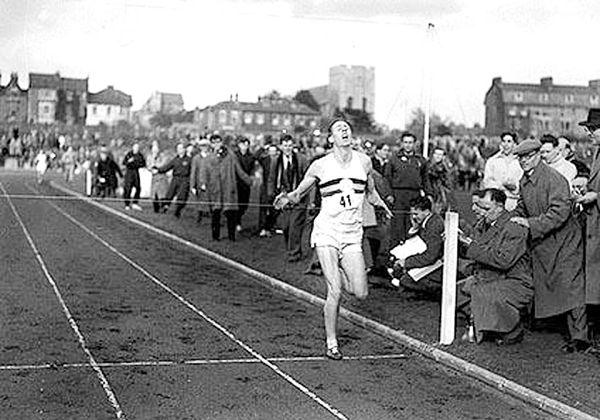
In our Team Building activities, we try to help our clients gain new knowledge or replace certain behaviours with more productive ones, and we've repeatedly highlighted the power of self-fulfilling prophecies.
Before 1954, running a mile (1.6 km) in under 4 minutes was considered impossible, something beyond the reach of any athlete or human being. And this wasn't just a perception among elite athletes — a large number of doctors and specialists had documented that the human body's physiological limit sat at that 4-minute mark, predicting that threshold could never be crossed.
But there was someone in the early 1950s who dared to challenge both doctors and athletes — his name was Roger Bannister, who prophesied: "It's possible to run a mile in under 4 minutes — in fact, I'm going to be the one to do it." At the time, Bannister was balancing his medical studies with athletics, going on to win a bronze medal at the European Championships and taking part in the Helsinki Olympics, finishing a respectable 4th place. At that time Bannister had a personal best of around 4 minutes 10 seconds in the mile, some way off the best in the world, which is why his prophecy wasn't taken too seriously. Through effort and dedication, he managed to bring his time down to around 4 minutes 2 seconds, on par with the best, and for a while it didn't seem he'd be able to go below that. But far from giving up, he repeated that he'd be able to break the 4-minute mark, and after commendable preparation, the big day wasn't long in coming.
On May 6, 1954, Roger Bannister ran the mile in 3 minutes 59 seconds. The world's most prestigious newspapers ran it on their front pages, calling the feat the miracle mile, praising humanity's ability to go beyond its limits. For decades, no human had been able to achieve it, but a year after Roger Bannister did it, more than 300 athletes were able to run a mile in under 4 minutes. Naturally, several questions arose. Had athletes' training methods changed? Had technology evolved and improved the shoes runners used? Absolutely not — it wasn't a matter of overcoming a physical barrier, as doctors and specialists had assumed, it was about breaking a psychological one.
As we explain in our Team Building sessions, beliefs are self-fulfilling prophecies, determining how we face a challenge, how we act when confronted with a difficulty. By defining a situation in a particular way, whether positively or negatively, we adopt a belief about what the final outcome will be, which leads us to bring the resources, attitudes and behaviour that will steer us towards what we believe will happen. As the great Henry Ford wisely said, "Whether you think you can, or you think you can't – you're right." Our ability to reach our goals is, to a great extent, based on the beliefs we hold about our own skills and abilities, so as you now know, if you believe you can, you can.
At Kaizen we'll help you achieve all your goals, whether through Team Building activities, corporate activities, or team coaching sessions.
We design the activity around your company and send a no-obligation quote within 24 hours. Here are some of the most popular:
Team Building
September and October are the ideal time to reconnect your team. Here is why autumn is the best seas…
Read more Team Building
Team building in nature encourages a real digital detox and reduces team stress, thanks to a wide ra…
Read more Team Building
How to design sustainable team building by cutting waste and travel, with activities that build in a…
Read more