 Team Building
Autumn team building: back-to-school activities for your company
September and October are the ideal time to reconnect your team. Here is why autumn is the best seas…
Read more
Team Building
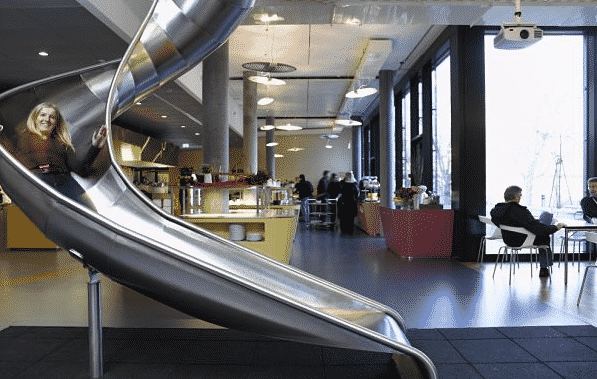
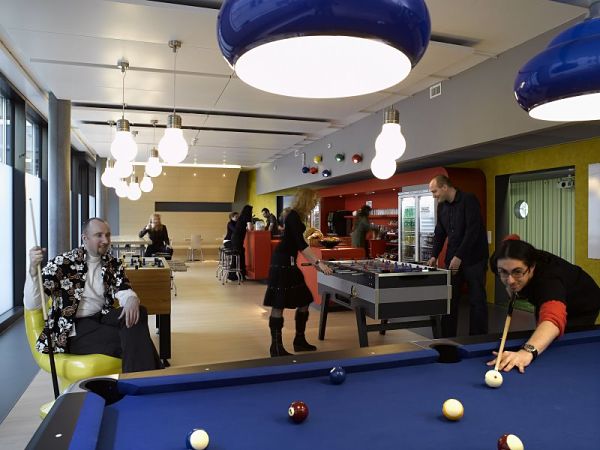
If we mention the term leisure at work, surely the first image that comes to mind is the almighty Google and its colourful offices, full of arcade games and video games, massage rooms, pool tables, food and drink machines… and even slides connecting the different floors of the building! as shown in a recent photo of their dazzling Zurich offices.
All of this is surprising in a country like ours, with a much more traditional image and concept of the workplace, but one that's gradually opening up and incorporating certain motivation tools and strategies in the pursuit of more competitive, effective teams.
What's beyond doubt, and where all experts seem to agree, is that incorporating leisure at work helps build more motivated, happy and effective work teams. It's not just about creating a better, more pleasant environment for employees. It also involves developing and launching leisure activities (both within the company and by organising specific events and outings), which undoubtedly helps employees feel like an integral part of a group, identifying better with the brand, and giving the company a powerful tool to help retain talent.
On the other hand, it's also worth highlighting certain studies showing that having leisure elements and spaces at work helps reduce stress and renew employees' energy during the workday. For example, the publisher Plos One recently published a report claiming that real-time strategy video games could improve our cognitive capacity and flexibility, something that, applied to the workplace, could be very interesting.
From our experience as experts in developing Team Building activities for companies, we see more and more organisations (large and small) in our country (especially in Madrid, Barcelona and Valencia) understanding the need for a healthy environment that fosters human relationships between employees. And for this, the company must be the one to take the first step, proposing, encouraging and offering options to build that unity and cohesion within its teams.
From informal after-work dinners, to creating sports groups, teams and tournaments (football, running, table tennis), to larger-scale events with corporate activities and team building (indoor and outdoor) aimed at working on specific aspects: unity, team communication, trust, leadership, etc. And all of it, with music, sport, art, creativity… taking centre stage, bringing unique experiences to life, both individually and collectively.
That's why it's no longer unusual for large companies to start creating specific departments within their own structure, dedicated to working on and thinking up new activities and incentives for employees, in pursuit of a more pleasant atmosphere that fosters socialising among employees and boosts teamwork and, of course, its results.
As always, we stress the need for professional guidance when launching a Team Building programme or an employee leisure and incentive programme at your company. The possibilities are many, as are the goals to achieve, which is why designing an activity or plan tailored to each team is essential.
What's beyond doubt is that leisure at work and productivity don't seem to be opposing concepts at all. Quite the opposite, in fact. Happier employees, in more pleasant, united environments, make better companies possible.
We design the activity around your company and send a no-obligation quote within 24 hours. Here are some of the most popular:
Team Building
September and October are the ideal time to reconnect your team. Here is why autumn is the best seas…
Read more Team Building
Team building in nature encourages a real digital detox and reduces team stress, thanks to a wide ra…
Read more Team Building
How to design sustainable team building by cutting waste and travel, with activities that build in a…
Read more