 Company Activities
Team Building for Logistics and Warehouse Teams: How to Get It Right
Why warehouse and logistics teams almost never get team building, and which formats really work with…
Read more
Company Activities
When people think of team building, the image that usually comes to mind is a big convention with hundreds of people spread across several activity stations. But the reality for many companies in Spain is very different: teams of eight, twelve, or twenty people who also need moments of cohesion, and who sometimes rule out organizing an activity because they assume team building only makes sense with large groups. Nothing could be further from the truth. Team building for small groups isn't just possible — in many cases it turns out to be more intense and more effective than a big convention, precisely because it allows for a closer, more personalized experience. In this article, we look at why small groups have advantages of their own, which activities work especially well in these cases, and what to keep in mind to get the most out of them.
There's a fairly widespread idea that a team activity only has real impact when it brings together a lot of people. That's a misconception: the impact of a team building event doesn't depend on the number of participants — it depends on how well the activity is designed for the specific group experiencing it.
In fact, small groups have advantages that large groups simply can't offer. In a team of ten or fifteen people, each participant plays a much bigger role within the activity, there's less downtime waiting for a turn, and the facilitator can give individualized attention to each person, adjusting the pace of the activity on the fly. What's more, in many cases small groups already know each other quite well professionally, which means you can go straight into deeper activities without needing to spend time on basic introductions.
There's also a practical advantage that shouldn't be underestimated: smaller groups usually find it easier to agree on common dates, travel together to a specific venue, or fit into indoor formats with limited capacity, like private escape rooms, culinary spaces, or casino-style formats, which simply wouldn't be viable with hundreds of people.
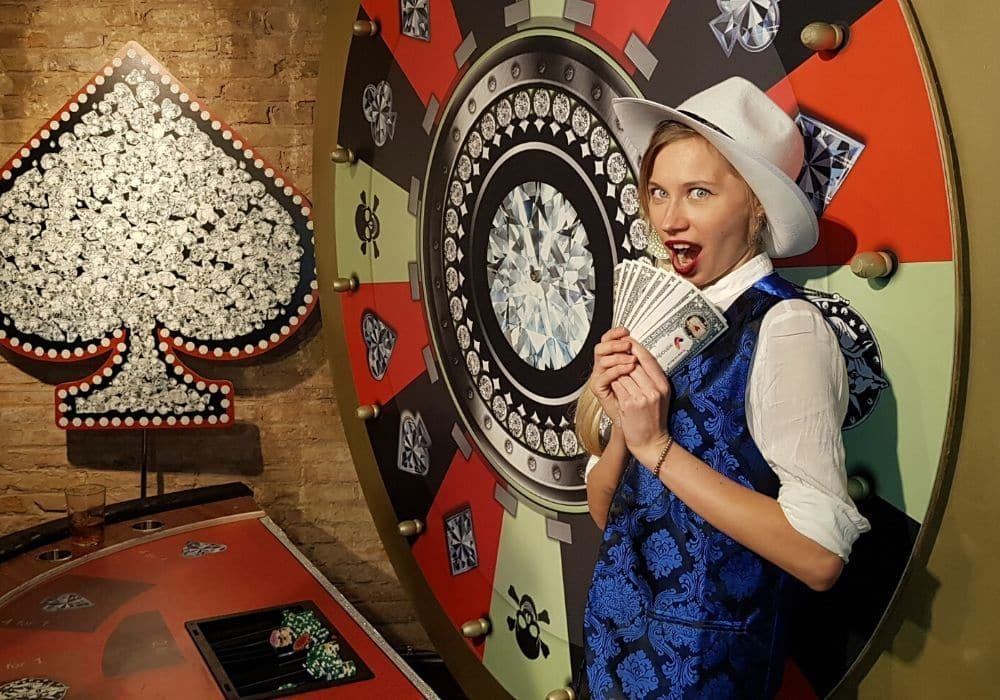
Formats that recreate a casino atmosphere, like Casino Clandestino, work especially well with small groups because they create a relaxed atmosphere with plenty of direct social interaction between participants, without needing large venues or a complex technical setup. It's a format that fits very well as a closing activity for the day or as part of a smaller company dinner.
Activities centered on food and drink, like a Wine Tasting or a molecular mixology experience, are formats that gain a lot from smaller groups, because they let each participant receive more detailed explanations, take an active part in every step of the process, and enjoy a sensory experience that gets diluted quite a bit when the group is very large. They also tend to combine the team building element very well with a relaxed social moment, ideal for teams looking for more cohesion than competition.
Collaborative building formats, like LEGO®-style activities, also adapt very well to small groups, since they allow the team to be split into smaller subgroups or even work all together on a single shared challenge, with a much higher level of individual involvement than in large-scale formats.
When a small team's goal goes beyond simply disconnecting and also aims at developing skills, activities with a corporate coaching component take especially good advantage of the small-group format, because they allow for a level of personalized attention and individual participation that would be much harder to maintain in a group of a hundred people.
It's not enough to take any activity designed for large groups and simply reduce the number of participants; there are a few specific aspects worth keeping in mind so the experience works well with a small number of people.
A good team building provider will know how to recommend the right format based on your team's exact size, rather than suggesting an activity originally designed for hundreds of people and simply scaled down on paper.
Small teams looking for a cohesion activity don't always fit the same profile, and it's worth distinguishing a few common cases:
In all these cases, what matters isn't the size of the group but whether the activity is well thought out for that specific context. You can explore the full catalog of team building activities, filtering by indoor or small-group formats, to get a fuller picture of the options available.
Before wrapping up, it's worth debunking a couple of ideas that hold many small companies back from organizing their first team activity:
There's no universal number, but in practice we usually talk about small groups when the team has roughly between five and twenty-five people. Below that number, many activities still adapt just as well, simply by adjusting roles and timing; above it, certain formats start to benefit from the energy that comes with larger groups.
Yes, it's a common option when several small departments want to share an activity without giving up the advantages of an intimate format. In these cases, it's best to keep small subgroups within the overall activity, so you don't lose the closeness that makes this kind of team building special.
Generally yes, although careful planning is still just as important. A smaller group allows more room to adjust dates and last-minute details, but that doesn't mean the activity should be improvised: the quality of the experience depends on how well the activity is designed, not on the size of the group experiencing it.
Both options are valid for small groups. Holding the activity at your own premises cuts travel costs and is logistically more convenient, while an external venue helps the team fully disconnect from their usual work environment, something many companies especially value for culinary or casino-style activities.
At Kaizen, we've spent more than 15 years working with teams of every size, from groups of fewer than ten people to large company conventions, and we know that a small group isn't a lesser version of team building — it's a different opportunity with its own potential. With more than 50 different activities and a presence across Spain, we've already helped more than 500 companies find the activity that best fits their team, whatever its size. If you have a small team and want to organize an activity that truly makes the most of that closeness, write to us through contact, and we'll help you design, with no obligation, the experience that best suits your group.
We design the activity around your company and send a no-obligation quote within 24 hours. Here are some of the most popular:
Company Activities
Why warehouse and logistics teams almost never get team building, and which formats really work with…
Read more Company Activities
Why healthcare staff need team building that fits around their shifts, and how to design inclusive, …
Read more Company Activities
Incentives and team building are not the same thing: one rewards individual results, the other stren…
Read more