 Leadership Management
Team building and occupational health and safety: cohesion as a boost to your safety culture
How trust and communication between colleagues, built through team building, strengthen your risk pr…
Read more
Leadership Management
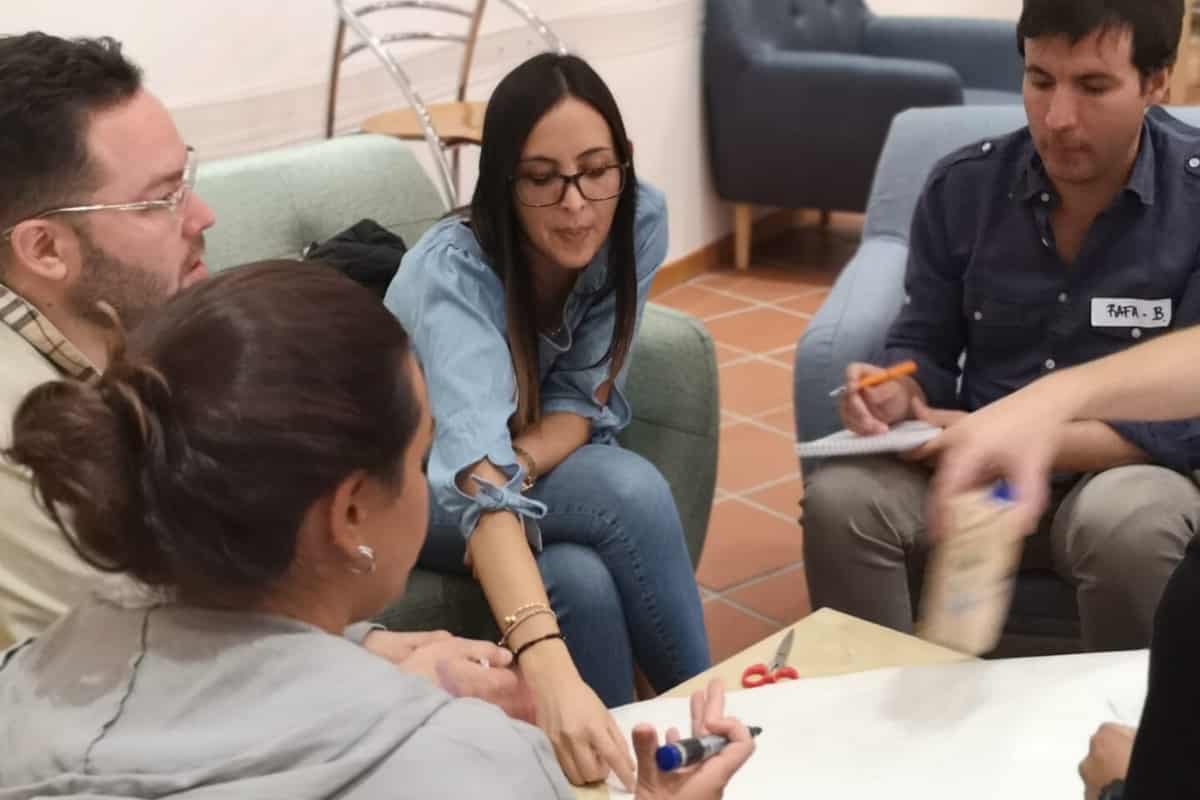
Leadership isn't learned just by reading management theory or attending a one-off talk: it's developed by practicing, making mistakes in a safe environment, and receiving honest feedback on how one's own way of leading others actually comes across. Many companies invest in leadership training focused exclusively on theoretical content, and later wonder why that knowledge doesn't translate into real behavioral change. Leadership-focused team building offers something different: a practical setting where team leaders can exercise skills such as delegation, listening, and managing pressure, with the rest of the team as a direct witness. In this article, we look at which leadership skills can be developed this way, which activities are most useful depending on the goal, and how to keep the experience from becoming just a nice anecdote.
Leadership training programs tend to be very solid on content: management models, leadership styles, communication techniques. The problem isn't the theory — it's the transfer to practice. It's relatively easy to understand, in a training room, what active listening is or why it's worth delegating instead of controlling every detail. It's much harder to apply naturally when you're under real pressure, with a real team, and with real consequences if something goes wrong.
Team building partly closes that gap because it places the person leading in a situation with real — though low-risk — pressure, in front of their own team. Knowing the theory isn't enough there: it has to be applied in real time, and the result shows up immediately in how the group reacts.
Many leaders, especially those who've recently been promoted from a technical role, struggle to let go of control and trust that others can take on responsibility with their own good judgment. Team building activities that require splitting tasks under time pressure force exactly this kind of practice: deciding quickly who to trust and accepting that the outcome won't depend solely on one's own decisions.
Other activities are specifically designed to test the ability to listen before deciding. A good example is Lego Serious Play, a methodology that uses hands-on building so that every person on the team can express ideas they might never voice in a conventional meeting, and which requires the person leading to weave those contributions into a shared vision rather than impose their own.
Activities with challenges to solve within a limited time are also good training for practicing how to communicate decisions under pressure, stay calm when something doesn't go as planned, and project confidence to the team without slipping into either authoritarianism or paralysis.
Beyond general team building activities, there are formats designed explicitly for developing management skills. Corporate coaching applied in a group format allows real leadership situations to be worked through in a guided way, with the help of a professional who facilitates reflection and feedback among the participants themselves. For companies looking for a more structured approach with specific content, training-focused team building combines hands-on activity with guided learning modules, which is especially useful when the goal goes beyond having a good time and aims for measurable skills development.
Not every management team needs to work on the same thing. Before choosing an activity, it's worth asking what specific competency you want to strengthen: if the problem is that middle managers over-control, the focus should be delegation; if decisions are being made without listening to the team, the focus should be active listening; if the problem is crisis or contingency management, it's worth prioritizing activities with real time pressure. Choosing the activity based on the goal, rather than the other way around, is what makes the difference between a pleasant day out and an experience that actually changes behavior.
If you're unsure which format best fits your management team, checking our team building FAQ first can help clarify how these sessions are structured before you decide.
One of the elements that most strengthens the developmental effect of a leadership-focused team building activity is building in an explicit moment for feedback from the team to their managers, something that's much harder to achieve day-to-day because of the hierarchical gap. During a shared activity, in a more relaxed setting than a formal evaluation, people tend to feel more comfortable pointing out, for example, that their manager tends to interrupt before hearing the full proposal, or rarely acknowledges good ideas from the team in public.
For this feedback to be useful rather than a source of tension, it should be facilitated through a well-designed activity that encourages constructive, specific comments rather than generic criticism. When handled well, this kind of feedback is extremely valuable precisely because it comes from the people who deal with that person's leadership style every day, rather than from an outside evaluation with no ongoing contact.
The biggest risk with any training activity, including leadership-focused team building, is that the learning stays locked inside the event itself and never carries over into daily practice. To prevent this, it helps a lot to set aside time at the end of the activity for each manager to say out loud what they've learned about their own leadership style and what they're going to try to do differently going forward. It's also useful to revisit those commitments a few weeks later, in a brief conversation, to check whether they've actually translated into behavioral change or faded into a passing good intention.
Repeating these kinds of experiences periodically, rather than organizing them as isolated events, also makes it possible to track each leader's progress over time and spot earlier whether someone needs more individualized support.
Before investing in any leadership-focused team building format, it's worth making an honest diagnosis of where the real gaps are, rather than assuming every manager needs to work on exactly the same thing. A simple way to start is to look for patterns that repeat in the team's informal complaints: if several people, at different times, mention that decisions are made without consulting them, the problem is likely listening. If the recurring complaint is that everything always has to go through the same person and nothing moves forward when that person is unavailable, the problem is probably delegation.
It's also useful to watch how different managers react to a real, unexpected situation: who stays calm and communicates clearly, and who tends toward paralysis or an abrupt reaction. These everyday observations, while no substitute for a formal skills assessment, offer very reliable clues about which type of leadership development activity would make the most sense to prioritize first.
The leadership model expected of a team manager today has changed markedly compared to just a decade ago. It's no longer so much about overseeing every task as about enabling the team to function well with relative autonomy, removing obstacles and connecting the right people at the right time. This shift is especially demanding for those who were trained, or promoted, under a more hierarchical, control-oriented management style.
Team building is particularly useful for practicing this new facilitator role, precisely because it places the leader in activities where unilaterally imposing their own view tends to produce worse results than helping the team reach a good solution together. Repeating this experience several times, with different types of challenges, helps internalize a management style much better suited to what's expected of a good team leader today.
Developing better leaders doesn't depend on theory alone — it depends on sustained practice over time. At Kaizen Team Building, we've spent more than 15 years designing team building and leadership development activities for companies across Spain, with over 50 different activities and the trust of more than 500 companies that have already worked with us. If you'd like a proposal tailored to your management team's specific needs, reach out through our contact form and we'll help you design it.
We design the activity around your company and send a no-obligation quote within 24 hours. Here are some of the most popular:
Leadership Management
How trust and communication between colleagues, built through team building, strengthen your risk pr…
Read more Leadership Management
Team building as an employer branding tool: authentic content for social media and recruitment, and …
Read more Leadership Management
Absenteeism is closely linked to a sense of belonging. Find out how team building can help strengthe…
Read more