 Company Activities
Team Building for Logistics and Warehouse Teams: How to Get It Right
Why warehouse and logistics teams almost never get team building, and which formats really work with…
Read more
Company Activities
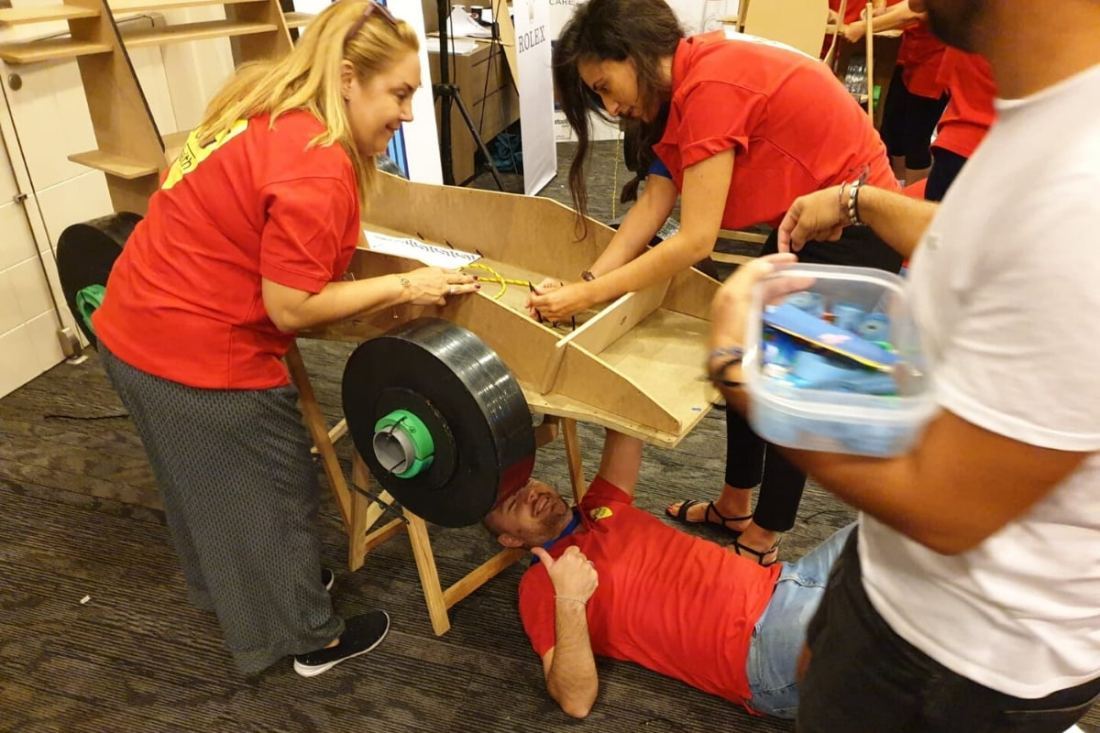
It is common in a single management meeting to hear "organising an incentive" and "doing team building" used as if they were interchangeable synonyms. They are not, and confusing them often leads to choosing the wrong format for the problem you actually want to solve. Understanding the difference between a company incentive and team building is not a semantic nicety: it completely changes who the activity is aimed at, what goal it pursues and, above all, what result you can expect from it.
An incentive is, in essence, a reward. It is granted to specific people or teams as recognition for having achieved certain results: exceeding a sales target, closing an especially good year, hitting an important company milestone. Its logic is individual, even if it is enjoyed as a group: not all employees take part equally, only those who have "earned" it according to previously established criteria.
The typical format of an incentive is a trip, an exclusive experience or a stay at an attractive destination, with a strong element of enjoyment and switching off. The company is not looking, first and foremost, for that group to work better as a team on its return; it is looking to recognise effort already made and to motivate people to repeat it in the future. It is, at heart, an individual motivation tool in the form of a collective experience.
An important part of an incentive's value lies precisely in its aspirational nature: not everyone achieves it, and that exclusivity is what makes it a desirable goal. An incentive trip is usually announced in advance as the reward for a specific objective, which creates additional motivation throughout the whole period in which that objective is at stake, whether that is a quarter, a sales campaign or a full financial year.
Team building starts from a completely different logic. It is not a reward but an investment: the company organises an activity for a whole team, department or even the entire workforce, with the explicit aim of improving how those people work together. It does not matter whether the team has had a good or bad quarter; team building is not earned, it is needed, and it is usually needed on a recurring basis, not as a one-off, isolated event.
The focus of team building is on the process, not on individual results: how the team communicates, how it resolves conflicts, how people trust each other, how new profiles are integrated. Activities are usually designed specifically to generate those dynamics, whether through challenges that demand coordination, creative activities that bring out different ways of thinking, or simply shared spaces where the usual office hierarchy fades a little.
To see it clearly, it helps to compare the two concepts along several specific lines:
Nothing stops a company from organising both types of event, and in fact many do: an incentive trip for the sales team that has exceeded its targets and, separately, regular team building sessions for the whole workforce. They are complementary tools, not alternatives where you have to choose one once and for all.
An incentive works well when there is a clear, measurable business objective you want to drive, especially in sales teams where individual performance is easy to quantify. It also makes sense when the company wants to publicly recognise those who have stood out, reinforcing a culture of meritocracy and recognition of effort. It works less well, on the other hand, when it is used as a patch for an underlying problem in the relationship between teams: an incentive trip will not fix a department where two areas have not understood each other for months, because that is neither its purpose nor its design.
Team building makes sense almost any time there is a team working together on an ongoing basis, but it is especially necessary at certain moments: when many new people have joined in a short time, when two teams have merged after a restructuring, when there is tension or a lack of communication between departments, or simply as periodic maintenance of cohesion, just as you carry out preventive maintenance on any other important company asset. Unlike an incentive, it does not depend on results: a team going through a rough patch needs team building as much as, or more than, one that is flush with results.
Although conceptually they are different things, some activity formats work well in both contexts, adapting the approach and the message around them. A Wine Tasting or a wine and tapas experience, for example, can be set up as an exclusive celebration for a team that has hit its targets, working then as an incentive, or as an activity open to a whole department with the aim of encouraging relaxed conversation between colleagues, working then as team building.
Something similar happens with a Speakeasy Casino night or team mini-Olympics: these are formats with a festive, aspirational touch that suit an incentive for a small group, but also work perfectly as a cohesion activity for the entire workforce, as long as they are designed with that specific goal in mind and do not end up being "just another party".
The key is not so much the format of the activity itself, but how it is set up: who is invited, what message is communicated before and during the event, and what you hope to achieve afterwards. The same activity, with a different approach, can be an incentive or a team building session.
Before booking any activity, it is worth asking yourself a simple question: is the problem or opportunity I want to address individual or collective? If the aim is to recognise and motivate specific people or teams for results already achieved, the answer points towards an incentive. If the aim is to improve how a team, large or small, works and relates day to day, the answer points towards team building.
In many companies, especially those that are growing or going through major organisational change, both needs exist at the same time, and there is no need to choose between them: it is simply a matter of not confusing them and designing each event with the right objective in mind. If you have doubts about which format best suits your company's current situation, at our team we can help you assess it with no obligation, and you can also read our frequently asked questions about team building or look at our team building proposals in Barcelona if your company is in that area.
Beyond the theory, in day-to-day practice some very specific mistakes crop up that are worth avoiding both when designing an incentive and when designing a team building session.
Avoiding these mistakes does not require big budgets or complex structures: above all, it requires being clear from the start about what you are organising and why, and communicating it that way to the team, rather than letting everyone interpret the event in their own way. A well-designed incentive reinforces meritocracy without creating resentment; well-designed team building improves the way the team works without depending on one-off results. When both are designed with that clarity, they stop competing for the same budget and start complementing each other within the company's overall people strategy.
Confusing incentive and team building usually leads to badly invested budgets: companies that spend on exclusive trips expecting them to solve internal communication problems that format was not designed to solve, or companies that organise large-scale cohesion activities when what they really needed was to recognise the effort of one specific team. Understanding clearly what each one is, and what each is for, is the first step towards making sure your investment in company activities delivers the result you expect from it.
We design the activity around your company and send a no-obligation quote within 24 hours. Here are some of the most popular:
Company Activities
Why warehouse and logistics teams almost never get team building, and which formats really work with…
Read more Company Activities
Why healthcare staff need team building that fits around their shifts, and how to design inclusive, …
Read more Company Activities
Find out why marketing teams need a different kind of team building, and which activities work best …
Read more