Some team building activities need a long explanation, while others make sense the moment you hear about them. The Mini Olympics is one of the latter: teams competing in a series of challenges, a tournament atmosphere and, at the end, a medal ceremony. That familiar format is part of its strength, because everyone knows what is expected and gets into the spirit from the very first minute.
Even so, there is a big difference between simply getting the team together to compete and organising a Mini Olympics that really works. In this article we explain how the activity runs at Kaizen, what each group works on, what is worth bearing in mind and when it is a good choice.
What is a company Mini Olympics?
It is a company game played as a team competition. Participants are split into teams, compete in a series of challenges and collect points on the way to a final victory. It is not about who is stronger or faster, but about the team organising itself, coordinating and having fun while doing so.
It is an activity with a long tradition in team building and has been run countless times, which has allowed the format to be refined: the timings, the explanations and the pace of the day.
How it works
At Kaizen, the activity follows this sequence:
- Splitting into teams. Participants are divided up and organised into teams.
- The flag. Before competing, each team has to create its own flag. It is a simple first challenge that gets everyone to agree on something and gives the group an identity.
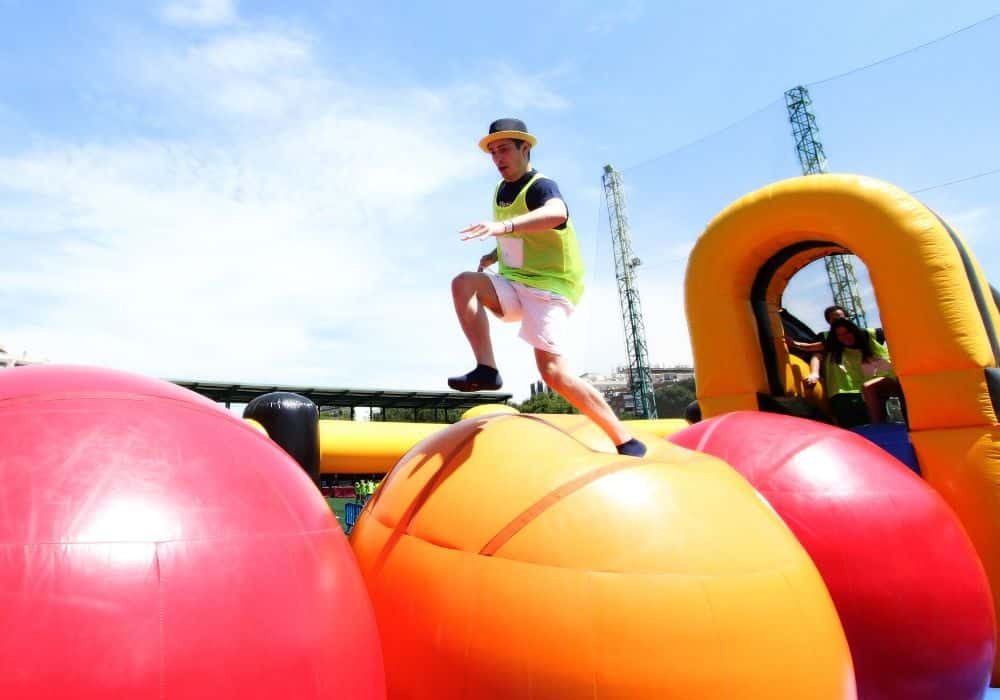
- The challenges. The teams take on a series of varied, entertaining challenges with low physical impact, focused more on collaboration and coordination than on effort.
- The commentary. A professional master of ceremonies narrates the teams' adventures like a live sports broadcast, with jokes and remarks that keep the atmosphere one of friendly competition.
- The judges. A group of judges or referees makes sure the challenges are carried out properly, so the competition is fair.
- The final ceremony. At the end, medals and trophies are presented.
What the team works on
The activity sheet lists effort, team spirit, creativity and coordination as the skills involved. In practice, this translates into some very recognisable things:
- Organisation. Each team has to coordinate to solve the challenges, which strengthens its ability to organise itself.
- Communication. Without smooth communication within the team, it is hard to get the challenges done.
- Natural leadership. The situation makes it easier for leaders to emerge in each group, people who take on responsibility without anyone having assigned it to them.
- Energy and motivation. Healthy competition lifts spirits and makes the day something people remember as fun.
- Relationships between colleagues. Competing together in a setting that is different from the office helps people get to know one another better.
How many people can take part?
The total group can range from 10 to 200 people, with teams of between 8 and 15 people each. That is a very wide range, which makes it one of the most versatile activities for large groups. If your company has a large workforce and wants everyone to take part at the same time, it is one of the easiest options to organise.
What is included and what you need
The activity includes instructors, referees or judges, a sports commentator and the materials for the challenges. The only thing you need to provide is a playing area. The venue is booked separately, and if you do not have a clear space in mind, we can help you find a suitable one.
Some practical tips when choosing the space: it should allow several teams to move around at the same time, there should be a shaded or covered area for breaks and, if there is a risk of rain, there should be an alternative. If you are looking for a day with more variety, the Family Day expands on this format with activities designed for families.
When it is a good choice
- Large groups. When the number of participants makes other, smaller activities difficult.
- Teams with very different profiles. The challenges have a low physical impact, so people with different levels of fitness can all take part.
- Team integration events. Conventions, anniversaries or the start of the year, when you are looking for a fun atmosphere and collective energy. You will find more ideas in our article on activities for a company anniversary.
- Teams that already know each other. It offers a different format, something that breaks the routine.
And when it may not be the best option: if the aim is a very reflective activity, based on conversation or on working through a specific topic, there are more suitable activities. In that case, you can have a look at 20 team building ideas for large events or our article on sports team building.
Frequently asked questions
How many people are there per team?
The total group can be from 10 to 200 people, with teams of 8 to 15 people each.
Do you need to be fit?
No. The challenges have a low physical impact and focus on collaboration and coordination, so people of different fitness levels can take part.
What is included?
Instructors, referees or judges, a sports commentator and the materials for the challenges. The venue is an extra.
Do you need a special space?
Just a playing area. If you do not have one in mind, we can help you find a suitable venue.
In summary
The Mini Olympics is one of the most direct ways to bring a large group together, let them compete in a friendly way and leave them with a good shared memory. Its strength lies in its simplicity: it is understood quickly, enjoyed almost from the very first minute and adapts well to different profiles. If you would like us to help you tailor it to your numbers, date and venue, tell us what you need and we will suggest some options.

 Event


