 Team Building
Autumn team building: back-to-school activities for your company
September and October are the ideal time to reconnect your team. Here is why autumn is the best seas…
Read more
Team Building
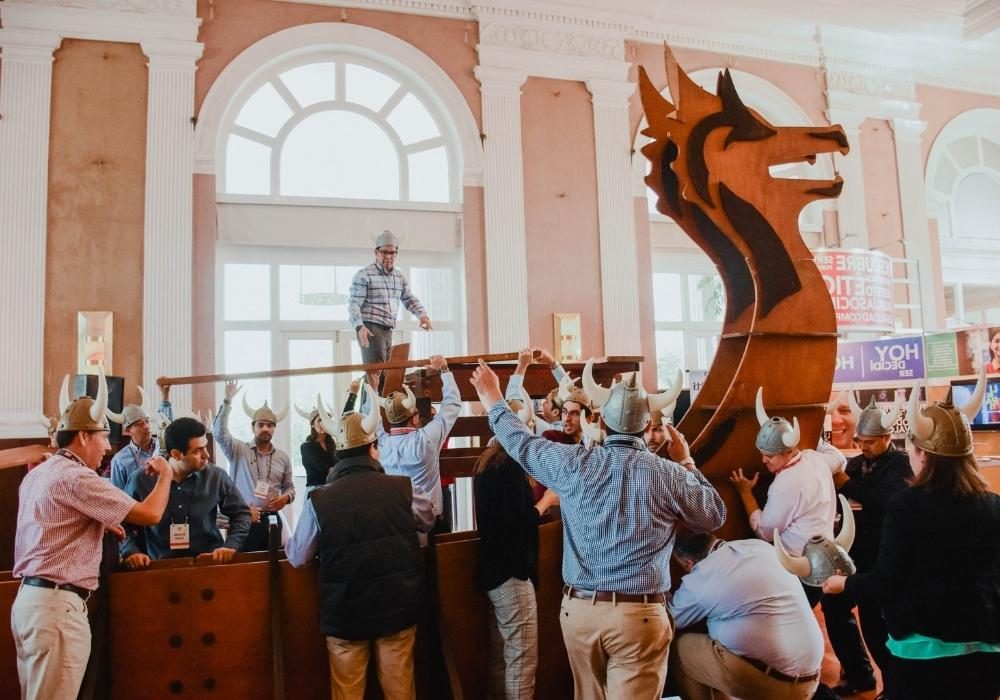
You've probably heard people talk about team building in a meeting, on LinkedIn, or because a colleague at another company told you their team came back thrilled from a "team building thing." But what exactly is it, and why are more and more Spanish companies putting part of their budget toward this kind of initiative? In this article we explain, without jargon, what team building is, where the concept comes from, how it differs from a Christmas dinner or a simple day off, and why it can become a useful tool for your organization, whatever its size or sector. By the end, you'll know whether your company is at the right moment to take the step.
The term team building literally means "building a team" and refers to the set of activities, dynamics, and experiences specifically designed to improve the way a group of people works together. We're not talking about pure entertainment, although the playful element is key, but about experiences with a purpose: helping the people who make up a team get to know each other better, communicate more fluidly, build mutual trust, and learn to collaborate more effectively when they return to their jobs.
A team building activity can take many different forms: from a gymkhana with physical and mental challenges to a cooking workshop, through problem-solving dynamics, strategy games, or outdoor adventure experiences. What they all share is the underlying goal: taking the team out of its daily routine and placing it in a different context where hierarchies blur a little, communication becomes more direct, and group dynamics emerge that rarely come to light in the office.
Team building is not a passing trend. It has been present in corporate culture for decades, although for a long time it was associated almost exclusively with large multinationals that organized annual conventions with activities built in. Over the years, and especially following the changes in how we work over the last decade, the concept has become democratized: today, companies of all sizes, from small startups to established SMEs and large corporations, include team building as part of their people management strategy.
This evolution is also reflected in the type of activities companies are asking for. While more generic formats used to dominate, today companies look for tailor-made experiences, aligned with their values, with specific objectives and, in many cases, with a built-in training or social responsibility component. It's common, for example, for companies to request activities that specifically strengthen communication between departments, or that help a recently merged team find common ground.
It's a very common mistake to confuse team building with any company social event. A Christmas dinner, a drink after work, or a lunch to celebrate the end of a project are valuable social events that improve the atmosphere and are necessary, but they aren't designed with a methodology behind them or aimed at a specific team development goal. Team building, on the other hand, starts from an intentional design: the activity is chosen, the challenge is tailored, the difficulty is calibrated, and, in many cases, a facilitator or dynamizer is brought in to guide the group and later help extract lessons from the experience.
This doesn't mean a team building activity can't also be fun — in fact, it must be for it to work. The difference is that behind the game there is a pedagogical intent: working on trust, active listening, shared leadership, managing pressure as a team, or collective creativity, among other aspects. That's why, when a company hires a team building activity, it's usually looking for more than just a good time: it's looking for that good time to leave a mark on how the team works the next day.
There are specific moments in an organization's life when team building is especially timely. One of the most common is the arrival of new people on the team: when several hires have been made in a short period, a joint activity helps newcomers integrate much faster than if they relied solely on day-to-day office life.
Another typical scenario is after a merger, an acquisition, or an internal restructuring, when people from different company cultures need to find a common language. Team building is also frequently used when communication between departments isn't flowing as it should, when there has been a particularly demanding period in terms of workload and the team needs to disconnect and reconnect, or simply as part of the company's annual routine, to maintain the bond between people who may work remotely and don't share a physical space every day.
In sales and commercial teams, team building is commonly used before the start of a new fiscal year, as a way to align goals and generate motivation for the months ahead. And in management teams, it's not unusual to combine the recreational activity with strategic reflection sessions, taking advantage of having the whole team together outside the usual office environment.
In large companies, the initiative usually comes from the Human Resources department, which has an overall view of the workplace climate and the budget assigned to this type of action. But in SMEs and smaller companies, where there isn't always a dedicated people department, it's common for senior management, a team leader, or even someone with their own initiative to propose it. You don't need to hold a specific position to raise the idea: what matters is that whoever drives it has the ability to secure budget approval and get the rest of the team on board.
In organizations with several departments, team building often also emerges as a joint proposal between two or more area managers who identify a shared need — for example, when two teams that need to collaborate closely aren't quite understanding each other. In these cases, involving middle managers from the start usually makes the organization much easier, because they know the internal day-to-day dynamics best and can anticipate what type of activity will best suit the group's personality.
Whoever drives the idea, it's worth having explicit backing from management, even if only symbolically: when the company shows it supports the initiative, it reinforces the message that team wellbeing and cohesion are a real priority, not just an isolated gesture from one department.
You don't need to wait for a serious problem to arise before considering a team building activity, but there are some signs that usually indicate the time has come. If you notice that communication between teams is limited to terse emails and messages, that there are silos between departments that barely interact with each other, that staff turnover has gone up, or that the general mood feels somewhat flat, it's probably a good time to act.
It's also worth thinking about team building in preventive terms, not just reactive ones. Many companies that have worked for years with solid, motivated teams keep investing in these activities periodically, precisely to maintain that good climate and avoid taking it for granted that it will sustain itself. If you have questions about which type of activity best fits your company's specific situation, our team building FAQ section answers the most common questions companies ask us before taking the step.
A well-planned team building activity isn't improvised. It starts by understanding the company's context: how many people will take part, what goal is being pursued, whether there's any internal dynamic worth taking into account, and what type of experience best fits the team's culture. From there, the activity is designed or adapted, the right venue is chosen, and all the materials and logistics are prepared so that, on the day of the activity, the company only has to worry about enjoying it together with its team.
Over more than fifteen years working with companies across Spain, at Kaizen we've learned that the true value of an activity lies not only in the moment it takes place, but in how it later translates into the team's everyday work. That's why every proposal is designed as a complete experience, not just an afternoon of entertainment.
If after reading this you think your company is at a good moment to invest in team building, we invite you to take a look at our catalog of activities, where you'll find a wide range of proposals designed for teams of all sizes and goals. And if you'd rather talk to us first about your specific case, you can contact us and we'll help you find the activity that best fits your team.
We design the activity around your company and send a no-obligation quote within 24 hours. Here are some of the most popular:
Team Building
September and October are the ideal time to reconnect your team. Here is why autumn is the best seas…
Read more Team Building
Team building in nature encourages a real digital detox and reduces team stress, thanks to a wide ra…
Read more Team Building
How to design sustainable team building by cutting waste and travel, with activities that build in a…
Read more