 Team Building
Autumn team building: back-to-school activities for your company
September and October are the ideal time to reconnect your team. Here is why autumn is the best seas…
Read more
Team Building
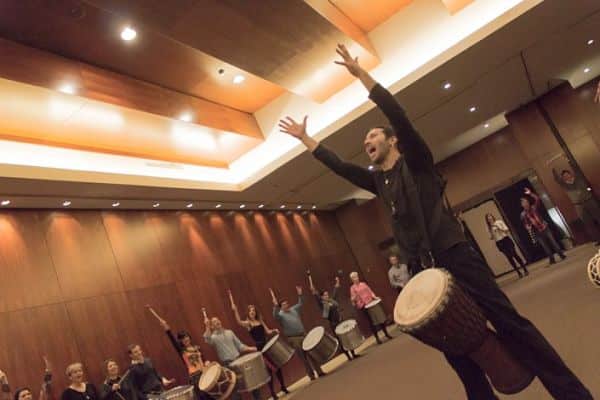
Percussion is probably one of the most ancient cultural forms still alive today. There's no African tribe where percussion isn't one of the most common ways to connect and communicate. Our musical Team Building aims not only to be an empowering, fun corporate activity, but also to improve aspects related to communication within your team.
The batucada is a musical style involving a group of percussion instruments. Its main characteristic is the emphasis on the second beat within each measure. It's sometimes considered a derivative of Samba. The batucada's origins lie in African cultures, where drum ensembles have always existed for mainly religious as well as popular festivities. Batucadas are found in African countries and in countries whose cultures have African roots. In our time, the batucada has recently flourished in Brazil, where batucadas form with more than 3,000 drummers and dancers, making the Brazilian batucada the prototype for the batucada movement we now see in Europe. What's more, this movement is creative. While Brazilian batucadas play traditional rhythms, European ones let themselves be influenced by other cultures from around the world. Our Team Building activity is based on the European style.
What percussion instruments will we use in our musical Team Building?
Surdos. A large circular drum with a deep, low sound. Its diameter ranges between 45 cm and 75 cm. Samba surdos typically have a depth of 60 cm. It's typically made of wood or metal and has skins on both sides. Its main function is keeping the tempo.
Tamborim. Similar to a drum, but with a narrower, more elongated body. It consists of a wooden cylinder up to 40 centimetres tall, covered on both ends with parchment heads 25 to 30 centimetres wide. This small Brazilian drum is often underestimated. In the past, musicians played their rhythms on the tamborim simply using a single wooden stick, or in small groups, and even just with their fingers.
Agogô. A musical instrument descended from double African iron bells. It's hard to pin down exactly when it was introduced to Brazil, probably in the mid-16th century by enslaved people belonging to the Yoruba nation. It's an instrument made from two iron bells joined by a curved arc, which also acts as a handle. Each bell has a different size and pitch. The instrument is held by the arc with one hand while the other strikes the different bells with a wooden or metal stick.
The analogy between a musical orchestra and any work team offers a very clear perspective on what teamwork means. Participants experience the meaning of collaboration, the importance of each part making up the orchestra, active listening, and contributing personal energy toward a shared goal.
If we play to the same beat, the same rhythm, it means we're listening to each other, that there's empathy, and that we can work as a team. Based on this concept, in our musical team building activity called "In Tune with the Team", we use percussion to run corporate activities aimed at strengthening teamwork and a sense of belonging, with a striking, captivating result. What do we achieve with this?
Percussion fosters internal team cohesion by breaking down barriers such as hierarchy, seniority at the company, gender, culture, language, religion, etc.
Reduce stress. After the team building activity, the group is more relaxed and receptive, which is why an interactive percussion session in the middle of long conferences, kickoff days, annual meetings or conventions tends to be an ideal activity to unwind.
At Kaizen Coaching and Team Building we offer an activity related to becoming aware of the internal pulse every work group has in how it functions as a team. To help understand this way of feeling the team's rhythm, we use percussion as the basic form of expression, since verbal communication isn't needed to build empathy and understanding with the rest of the team. Percussion lets us experience the strength of the group functioning as one — feeling it and dancing to it. The question is: do we work together and make music, or do we work without a collective awareness and just make noise?
Participants in our team building usually tell us that at the start of the activity they're not sure they'll be able to do it. In this country, we're generally not very familiar with this musical culture, so most groups have no prior experience. But within minutes, with the help of our expert facilitators, they're able to recreate rhythms in sync with their colleagues. This, combined with the deep, powerful sound of the drums, creates a motivating, highly rewarding atmosphere — just look at the wide smiles on the faces of everyone taking part in our musical team building.
So, with no prior musical knowledge required from participants, our professional percussionists will guide you through the process of forming a percussion group. A speaker leads this team building activity, steering it towards group awareness, whether it's a football team, an R&D department or an orchestra: in every case, the synergy of working together confirms that the sum of the separate parts will always be less than the strength we achieve when we work together, to the same beat. Drums let us live out this principle, feel it rather than just know it. And this is the great advantage of our team building — it's proven that to learn, you need to step out of your comfort zone, experiment, take a chance, and, above all, live the experience, which won't leave you indifferent.
At Kaizen Coaching and Team Building, we encourage you to experience this unforgettable moment with us, to feel the power of our drums and the joy of experiencing it together with your colleagues.
We design the activity around your company and send a no-obligation quote within 24 hours. Here are some of the most popular:
Team Building
September and October are the ideal time to reconnect your team. Here is why autumn is the best seas…
Read more Team Building
Team building in nature encourages a real digital detox and reduces team stress, thanks to a wide ra…
Read more Team Building
How to design sustainable team building by cutting waste and travel, with activities that build in a…
Read more