 Team Building
Autumn team building: back-to-school activities for your company
September and October are the ideal time to reconnect your team. Here is why autumn is the best seas…
Read more
Team Building
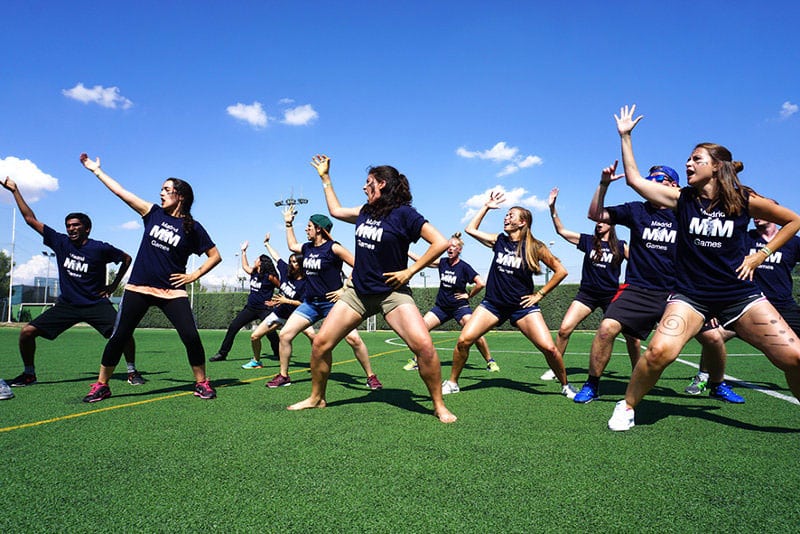
In the following two blog posts, we'll cover the Haka team building activity, which is tremendously motivating and ideal for improving cohesion and fostering a sense of belonging — goals every team building activity should pursue.
The Haka is a traditional Māori dance, historically used for different purposes, but basically as a challenge to rivals in war. Today it's still performed on various occasions, such as weddings, funerals, tributes, or as a sign of hospitality and a tourist attraction in different parts of New Zealand.
It consists of a dance made up of body percussion and chanting. It's performed in unison, and among its characteristic rhythmic movements are: strong stomping on the ground, arm movements, trembling hands, and the distinctive facial gestures and grimaces that would make more than one person nervous.
It can be performed by both men and women, although some hakas are specific to each gender.
The haka has become world-famous through New Zealand's national rugby team, the All Blacks, recently awarded the 2017 Princess of Asturias Award for Sports, and current world champions.
This peculiar dance belongs to Māori culture. Many of us know someone with a Māori tribal tattoo, but wait, where does this culture come from? According to the latest scientific studies, it's believed that around the 13th century, Polynesian peoples arrived in New Zealand and settled there. Over the centuries, they created their own language and culture. This makes the Māori the original people of New Zealand.
According to Māori mythology, the Sun God, Tama-nui-to-ra, had two wives, Hine-raumati, the Summer maiden, and Hine-takurua, the Winter maiden. The son from his relationship with the Summer maiden was Tane-rore, credited with the origin of this dance. Tane-rore represents the shimmer caused by the warm wind of summer days. In the dance, this is symbolised through the trembling movement of the hands.
The Ka Mate Haka is the most world-famous, and the one we learn in our Haka team building activity. If you talk to someone about the Haka, they might not know what you mean until you say the magic words: the rugby team's Māori dance. Indeed, most of us know this dance through the All Blacks, New Zealand's rugby team, even if we've never watched a rugby match in our lives.
Here's the story of the Ka Mate dance. It's said to have been composed around 1820 by Te Rauparaha, chief of the Ngāti Toa tribe. In times of war, while this chief was being pursued by a rival tribe, he was hidden by Te Wharerangi, of the Ngāti Tuwharetoa tribe, in a pit in a "kumara" (sweet potato) field, with the wife of the man who helped him escape sitting on top as cover. The Ka Mate haka is the story of this feat, narrated by the survivor.
kia rite! kia rite!
kia mau, hi!
Tinga ringa pakia
Waewae takahia kia kino nei hoki
kia kino nei hoki
Ka mate! Ka mate! Ka ora! Ka ora!
Ka mate! Ka mate! Ka ora! Ka ora!
Tenei te tangata puhuru huru
Nana nei i tiki mai
Whakawhiti te ra
A upa… ne! Ka upa…ne!
A upane kaupane whiti te ra!
Hi!
I die! I die! I live! I live!
Hands on hips, bend the knees
Slap the hands against the thighs
Stomp your feet on the ground as hard as you can
As hard as we can
I die! I die! I live! I live!
I die! I die! I live! I live!
This is the hairy man
who fetched the sun
and made it shine again
One step up! Another step!
One step up, another step, the sun shines!
There are theories claiming that "the hairy man" refers to Te Wharerangi, the friend from the other tribe who helped him survive the chase. The reference to the sun is due to his coming out of the pit he hid in while his rivals searched for him. In our Haka team building activity, we can replace a phrase with a company slogan or claim, since the point of the team building day is sometimes to reinforce a concept or product among attendees.
Every time the All Blacks play, before the start of each match they perform the acclaimed Haka. The power of their voices can be heard from the stands, which, in most cases, fall silent before such a glorious spectacle.
The Ka Mate Haka was first performed in the 1988/89 season by New Zealand's Native team, and in 1995 by today's well-known All Blacks. Since 2005, this fortunate team has had its own Haka, composed for and about the team. It was written by Derek Lardelli, an expert in Māori culture. This new Haka is called "Kapa O Pango", which basically means "the team in black".
The All Blacks perform either Haka alternately, at their discretion. As mentioned above, in our team building activity we'll work with the Ka Mate Haka.
https://www.youtube.com/watch?v=vYmszJ00aMM
Women have held great importance in the Haka's history. In the "Ka Eke i te Wiri" haka, the tribe's women were responsible for giving their approval to the young warriors preparing for battle.
In sport, the Black Ferns are New Zealand's women's rugby team, who have also just been crowned world champions. Their name means "black ferns", since the fern is New Zealand's quintessential symbol, though many people have mistaken it for a feather. The All Blacks also use this icon in their logo. It's said the silver fern tree has been on the island for more than a million years. Its leaves helped warriors find their way in battles as night fell, since their silver colour shone in the moonlight. These incredible fern leaves were also used in medicine and as food, so it's no surprise they've become a national emblem.
Although sadly not as well known as their compatriots the All Blacks, the Black Ferns team has won five women's rugby world cups.
As you might expect, they have their own Haka. "Ko Uhia Mai" is the name of the haka written by Whetu Tipiwai, which these champions perform before every match.
https://www.youtube.com/watch?v=X4QYcL8lab4
The haka isn't to everyone's taste, especially the rival teams who watch it performed up close at both women's and men's rugby matches. Several teams have been fined more than a thousand euros for "challenging" this dance. Among them are the Wallabies (Australia) and the French team. Many claim they start the match at a disadvantage after the New Zealand teams perform the haka.
Videos of "the best responses to the haka" also go viral, showing teams' reactions to this fearsome dance.
In short, Haka team building is a tremendously powerful, motivating activity, ideal for a work team to strengthen its bonds and commitments.
We design the activity around your company and send a no-obligation quote within 24 hours. Here are some of the most popular:
Team Building
September and October are the ideal time to reconnect your team. Here is why autumn is the best seas…
Read more Team Building
Team building in nature encourages a real digital detox and reduces team stress, thanks to a wide ra…
Read more Team Building
How to design sustainable team building by cutting waste and travel, with activities that build in a…
Read more