 Company Activities
Team Building for Logistics and Warehouse Teams: How to Get It Right
Why warehouse and logistics teams almost never get team building, and which formats really work with…
Read more
Company Activities
Among the wide range of Team Building activities and corporate activities we offer our clients in Madrid and Barcelona, there's a series of benefits implicit in all of them — for example, that they're perfect for stress management.
As Mario Alonso Puig explains in his book "Living is an Urgent Matter", stress is inherent to life. Therefore, eliminating it sooner or later means eliminating life itself. The key isn't to eliminate stress, but to manage it properly — to understand its nature, its causes, its origins, and the consequences that follow from failing to do so. This is what's known as stress management. And it's learned experientially during a Team Building day.
When starting an activity, facing a challenge, we're under the effects of positive stress, or eustress. Our blood carries a powerful mix of hormones, including adrenaline and noradrenaline, which keep our interest and sense of vitality alive and drive us to act. Dopamine also kicks in, giving us the ability to focus and avoid distractions, while also giving us a sense of pleasure. Alongside these, we also find serotonin, a hormone that greatly affects mood. It gives us a strong sense of confidence, helping us feel calm in the midst of the challenge, with the clear conviction that we'll be able to overcome it. But faced with the adversities we set, together with the urgency to overcome them, or due to the activity's duration, another form of stress emerges — negative stress, or distress. Our blood has seen most of its adrenaline, noradrenaline, and especially dopamine and serotonin disappear, filling instead with cortisol. That's why we feel exhausted, start getting irritable, and lose focus and memory. Negative emotions like fear and hopelessness replace confidence and excitement.
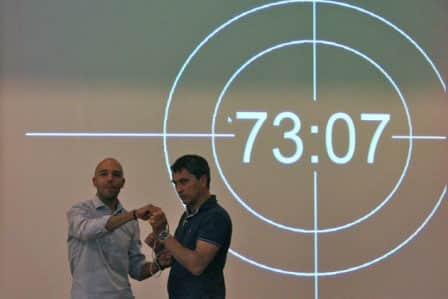
Our Defuse the Bomb Team Building activity is ideal for learning to manage stress. It's an activity in which a terrorist commando bursts into the room and plants a bomb with a countdown. Participants must overcome a series of challenges to get the code that disarms the bomb. A fabulous team building activity, ideal for working on stress management experientially.
Distress reactions don't only appear when we fail to recover from a sustained period of stress. They also occur when we've learned to feel incapable of facing challenges and uncertainty, like the ones we sometimes set during our activities. In this case, it's our way of thinking — this learned helplessness — that generates such significant, deeply limiting physical and mental changes. When we feel unable to solve something because we see ourselves inside the tunnel, we should start by getting used to reflecting, thinking that it's not that there's no way out or solution, but rather that, until we change our mental state, we simply won't find it.
When we see ourselves stuck in that dead-end tunnel, it's important to keep in mind that this circumstance isn't caused by a lack of important resources, such as intelligence, memory or imagination. The cause of this situation is what's known as a limiting mental state.
In distress, a very significant change occurs in blood flow to the brain. This change means some parts of it, specifically the prefrontal lobes, receive less blood. This lack of blood flow means neurons receive less oxygen and less glucose, which lowers their metabolism and impairs their function. The prefrontal lobes are essential for reasoning and attention processes, as well as for imagining the future and making decisions. Memory starts to pull up only the negative records stored within it. This means we start recalling only the negative episodes of our past, which leads us into a state of hopelessness and depression.
When someone feels capable of facing a challenge, whatever it may be, their body starts producing substances called neuropeptides, which aren't just powerful painkillers — these same neuropeptides also have the ability to cancel out the distress reaction. That's why it's essential that the more distressed a person is, and the higher the level of uncertainty, rather than falling into panic and negativity, they convince themselves and convey to others that they're capable of overcoming and resolving it, that there's a way out. Generally, we tend to adopt pessimistic, discouraged attitudes when the path becomes difficult. It's important to be aware that the smartest attitude is exactly the opposite.
Summary:
We design the activity around your company and send a no-obligation quote within 24 hours. Here are some of the most popular:
Company Activities
Why warehouse and logistics teams almost never get team building, and which formats really work with…
Read more Company Activities
Why healthcare staff need team building that fits around their shifts, and how to design inclusive, …
Read more Company Activities
Incentives and team building are not the same thing: one rewards individual results, the other stren…
Read more